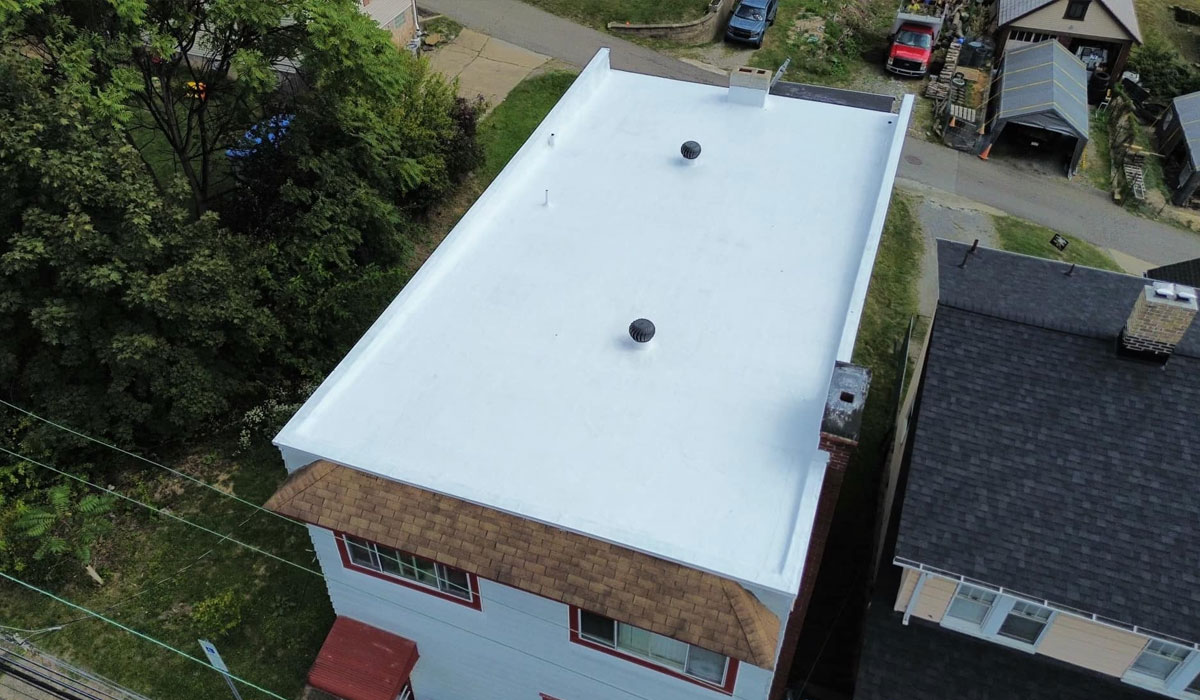
If you own or manage a commercial building around Pittsburgh, this is usually the first thing you ask me once I climb down off the roof. It’s a fair question. A flat roof is a serious investment, and you want to know how many years you’re buying. The short version: a well-installed TPO membrane typically gives you 15 to 25 years here, with premium systems stretching toward 30.
That’s really what people mean when they ask how long does a TPO commercial roof last in Western Pennsylvania. The honest answer is that it depends on a handful of factors, and most of them are in your control. Let me walk you through them.
How Long Should TPO Last?
Under normal conditions, TPO lasts 15 to 25 years. Premium membranes that are installed and maintained well can push past 30. That range is wide, but the spread isn’t random. It tracks closely with thickness, workmanship, drainage, and routine care.
Worth remembering: TPO roofing only became common in the 1990s, so the industry is just now watching its oldest systems reach the finish line. I’ve walked 12-year-old roofs failing at every seam and 24-year-old roofs with a decade of life left. The material didn’t change. Everything around it did.
How Long Does a TPO Commercial Roof Last in Western Pennsylvania?
Our climate is exactly why this question deserves a local answer. Western PA puts roofs through a brutal rhythm: freezing nights, thawing afternoons, and that swing repeating dozens of times each winter. Every freeze-thaw cycle forces the membrane to expand and contract, and that constant movement wears on seams and flashings over the years.
Add heavy snow loads, sticky summer humidity, and the occasional hailstorm, and you’ve got a roof that earns its lifespan. The good news is that TPO handles all of this well when it’s installed right. Its heat-welded seams flex with the temperature swings instead of pulling apart. Still, a neglected membrane in this region tends to land on the shorter end of the national range.
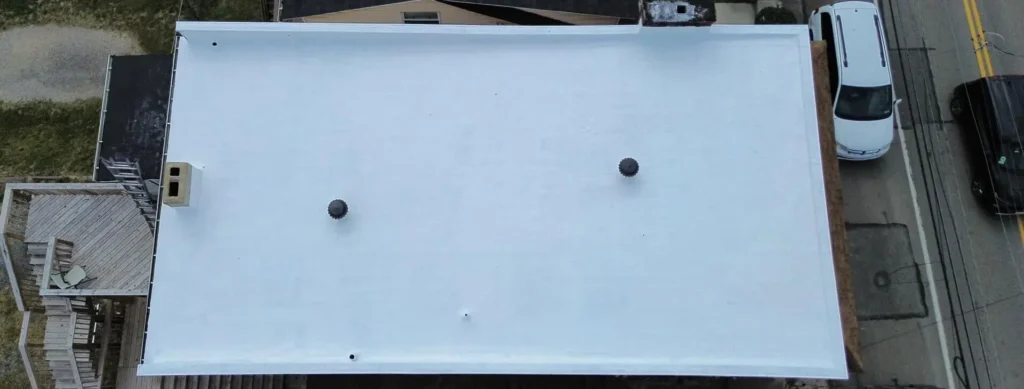
What Is the Typical Lifespan of a Commercial Roof?
TPO isn’t your only flat-roof option, and it helps to see where it sits. Most commercial systems around Western PA fall into a fairly predictable window, and the material you choose sets the ceiling.
| Roofing System | Typical Lifespan (Western PA) |
|---|---|
| Metal | 30–45 years |
| PVC | 20–30 years |
| EPDM (rubber) | 20–30 years |
| TPO | 15–25 years (up to 30 premium) |
| Built-Up / Modified Bitumen | 15–20 years |
Metal outlasts everything, but it carries a very different price tag and doesn’t suit every low-slope building. TPO earns its popularity by delivering strong, reflective performance at a lower cost than most of the pack. For a lot of owners, that balance is exactly the point. Keep in mind these are averages, not guarantees — a neglected metal roof can fail early, and a pampered TPO roof can outrun the chart.
Membrane Thickness: The Factor Owners Underestimate
If one spec moves the needle on TPO roof lifespan, it’s membrane thickness. TPO comes in 45, 60, and 80 mil, and a mil is just one-thousandth of an inch. Thicker sheets shrug off punctures, hail, and UV better, and they leave more wear layer above the internal scrim — the part that actually takes the sun and foot traffic.
A budget 45-mil membrane might give you 15 years. A 60-mil sheet, the sensible middle for most buildings, comfortably reaches 20-plus. An 80-mil membrane — the one I recommend for roofs crowded with HVAC units and service traffic — can run 25 to 30 years. One caution, though: thicker isn’t automatically better. Ask your contractor how much material sits above the scrim, because that number matters more than the mil rating on the box.
Why Installation Quality Makes or Breaks the Roof
Here’s the part nobody selling you a rock-bottom bid wants to discuss. Poor workmanship is the number-one cause of premature TPO failure. Period.
TPO seams are heat-welded, and a weld that runs a few degrees too cold or gets rushed will look perfect on day one and split three winters later. Flashing around parapets, drains, and rooftop units has to be detailed with care, because that’s where leaks almost always begin. I’ve been called to five-year-old roofs already leaking, and nearly every time it traced back to sloppy welds or corner-cutting at the penetrations. Good commercial roofing work isn’t glamorous, but it’s the whole difference between 12 years and 25.
The Ponding Water Problem
Standing water is the quiet killer of flat roofs. When water pools in low spots and sits more than a day or two after rain, it slowly breaks down seams, softens the insulation below, and invites mold. In our freeze-thaw climate it gets worse — that trapped water freezes, expands, and pries at the membrane from above.
Good drainage is the fix. Proper slope, clear drains, and unclogged scuppers keep a TPO roof performing the way it was designed to. After every big Western PA snowmelt, I tell owners to check their low spots and drains first. A puddle that dries within a day is normal; one that lingers for two or three is a warning. A ten-minute look can head off a five-figure repair.
How Often Should I Replace My TPO Roof?
You replace it when repairs stop protecting the building — not a day sooner, and hopefully not much later. A well-kept TPO roof shouldn’t need full replacement until it’s near the end of that 15-to-30-year window. Along the way, plan on professional inspections twice a year, plus a look after any major storm.
Isolated trouble — a puncture, a seam split, a bad flashing detail — can usually be welded and patched. But once leaks spread or the insulation is saturated, replacement is the smarter use of your money.
Warning Signs It’s Time
Watch for seams that lift or bubble, membrane that’s cracked or brittle, interior leaks that keep coming back, and low spots that never drain. Climbing energy bills can be a clue too, since a tired membrane reflects less heat than it used to. If you’re seeing several of these at once, get a professional up there before the next hard freeze.
What Is the Typical Depreciable Life of a Commercial Roof?
This one catches people off guard, because the tax answer and the physical answer are different. For IRS purposes, a commercial roof is treated as part of the building — nonresidential real property — and depreciated over 39 years using the straight-line method. That holds true even though the membrane itself may only physically last 20 to 30 years.
There’s a bright spot. Recent tax law lets many owners expense a qualifying roof replacement in the year it’s placed in service through Section 179, instead of waiting nearly four decades. I’m a roofer, not your accountant, so run the specifics past a tax pro. But it’s genuinely worth knowing before you budget a replacement.
Getting the Most Life Out of Your TPO Roof
So, how long does a TPO commercial roof last in Western Pennsylvania? Realistically, 15 to 25 years — and where you land in that range is largely up to you. Pick an adequate membrane thickness, insist on clean welding, keep water moving off the roof, and inspect twice a year.
It also helps that TPO’s bright, reflective surface acts as a cool roof, trimming your summer cooling costs. If you want the details on that, the ENERGY STAR cool roofs overview is a solid primer. And if you’d like to compare TPO against other systems for your property, our guide How Long Does a Commercial Roof Last in Pittsburgh? digs in further. When you’re ready for a straight answer about your own building, the crew at Malick Brothers Exteriors is glad to climb up and take a look.