

Roof expansion joints protect large commercial buildings in Cranberry Township by giving the structure a deliberate place to move. As temperatures swing, steel, concrete and membrane all expand and contract at different rates. The joint absorbs that movement so the roof assembly does not tear, split or pull apart at the seams.
That is the short version. The longer version matters more, because I've walked plenty of flat roofs in Butler County where a failed joint cost an owner far more than the joint itself ever did. Movement is not optional. A building will find a way to relieve stress whether you plan for it or not.
What is a roof expansion joint?
A roof expansion joint is a purposeful break in the roof assembly, running from the deck up through the insulation and membrane, that separates two sections of a building so each can move independently. Picture two curbs running parallel with a gap between them, bridged by a flexible bellows and capped with a metal cover. Nothing is rigidly fastened across that gap. When one wing of the building grows a half-inch on a hot July afternoon, the joint quietly takes it.
The best roof expansion joints are designed at the structural level, not added later as a patch. They typically line up with a structural expansion joint that runs down through the framing to the foundation.
Why Western Pennsylvania Weather Makes This a Local Problem
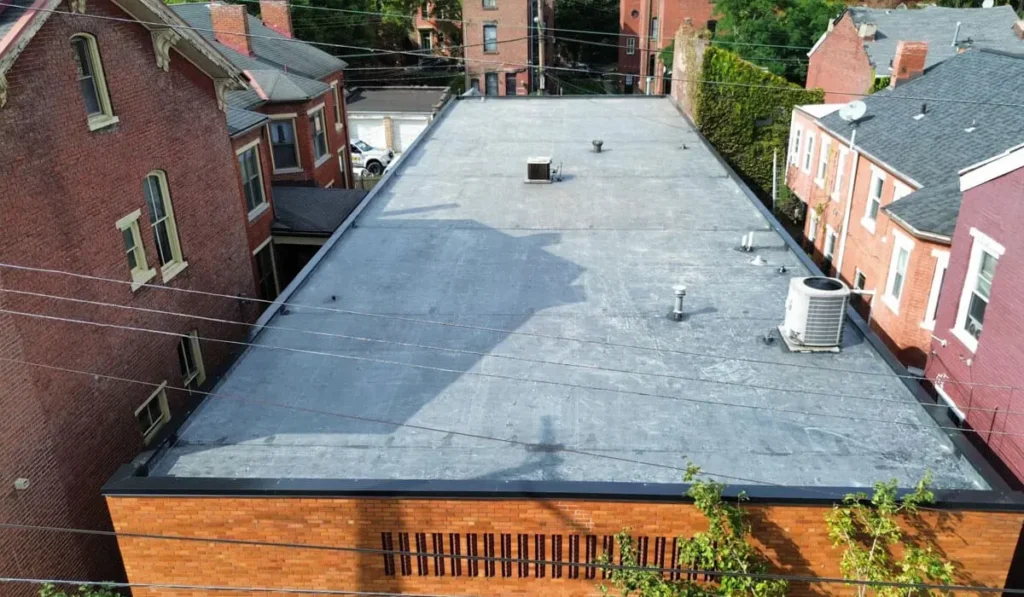
Cranberry Township sits in a climate that punishes roofs. Membrane surface temperatures on a dark low-slope roof can climb past 150 degrees in midsummer and drop below zero during a January cold snap. That is a swing of well over 150 degrees across a single year, repeated every year the building stands.
Then there is the freeze-thaw cycle. Our region runs through dozens of freeze-thaw events annually, and each one flexes the assembly a little more. Steel decking moves. Concrete moves less. Where two dissimilar materials meet without relief, something eventually gives.
What are the benefits of using expansion joints?
The benefits go well past leak prevention, though that is the one everyone notices first. A properly placed joint:
- Prevents membrane splits and ridging caused by accumulated stress
- Protects flashings, curbs and penetrations from being pulled out of position
- Reduces cracking in parapets, masonry and interior finishes
- Isolates additions from original structures so they can settle independently
- Extends the service life of the entire roof system, often by years
- Lowers long-term repair spend by keeping small movement from becoming structural damage
Here is the part owners appreciate. A joint is cheap insurance. Detailing one correctly during construction or reroofing costs a fraction of what a torn membrane and saturated insulation will cost you three winters from now.
Understanding How Roof Expansion Joints Protect Large Commercial Buildings in Cranberry Township
Large buildings have a specific vulnerability: length. The longer an uninterrupted roof plane runs, the more cumulative thermal movement builds up at its ends. A 400-foot warehouse roof can generate enough force to shear fasteners and buckle deck panels.
This is exactly how roof expansion joints protect large commercial buildings in Cranberry Township, by chopping one enormous, stressed roof plane into smaller sections that each behave predictably. Managing commercial roof movement this way turns an unpredictable force into a controlled one. The building still moves. It just moves where you told it to.
What buildings require an expansion joint?
Not every building needs one, but the candidates are fairly easy to identify. Structures with long roof spans, generally beyond 200 feet, almost always do. So do buildings with wings meeting at odd angles, or L-shaped and T-shaped footprints where two sections want to move in different directions.
You also need a joint anywhere framing changes direction or material, where an addition meets an original structure, and where interior climates differ sharply from one section to another. Think of a refrigerated warehouse attached to a heated office. Those two areas will never move in sync.
Expansion Joints, Area Dividers and Control Joints Are Not the Same
These three details look similar from a distance, and I've seen them confused on drawings more than once. They serve different jobs.
| Detail | What It Does | Where It Goes | Extends to Deck? |
|---|---|---|---|
| Expansion joint | Allows independent structural movement between building sections | Over a structural joint or framing change | Yes, full break through deck |
| Area divider | Relieves thermal stress within a single roof plane | Roughly every 150 to 200 feet on long roofs | No, sits on top of deck |
| Control joint | Manages minor movement where a full break is not practical | Flat plane of the roof surface | Partially |
The takeaway is simple. An area divider is not a substitute for an expansion joint when the structure itself is moving.
How to treat expansion joints in buildings?
Treatment starts with respecting the gap. Never fasten anything across an expansion joint, no conduit, no gas line, no walkway pad, no equipment support. I've found all four bridging joints on inspections, and each one turned a working detail into a rigid tie point.
The joint should be flashed on both sides according to manufacturer and industry details, with the membrane turned up and terminated independently on each curb. A flexible bellows spans the gap, and a formed metal cover with a standing seam or continuous cleat sheds water while still allowing travel. Guidance from the National Roofing Contractors Association remains the practical benchmark for detailing this correctly.
Twice a year, someone should physically inspect the cover, fasteners and sealant. That is the whole maintenance program.
Warning Signs a Joint Is Failing
Failing joints give plenty of notice before they leak. Watch for metal covers that have shifted out of alignment or developed open seams at splices. Look for fasteners backing out, sealant that has hardened and cracked, or ponding water along one side of the curb.
Inside, drywall cracks that reappear in the same spot after every repair often trace back to a roof joint that stopped working. Wet insulation directly below a joint line is the clearest signal of all. If you see any of these, get eyes on it before winter.
Making Expansion Joints Part of a Larger Maintenance Strategy
A joint inspection should not be a standalone event. It belongs in the same walkthrough where you are checking drains, seams, flashings and rooftop equipment. If you oversee several sites, that consistency matters even more, our guide on Commercial Property Maintenance: A Proactive Guide for Pittsburgh covers how to build that rhythm across a portfolio.
Document what you find. Photograph the joint from the same vantage point each visit. Year over year, those photos tell you whether movement is accelerating.
What I'd Tell Any Owner With a Big Flat Roof
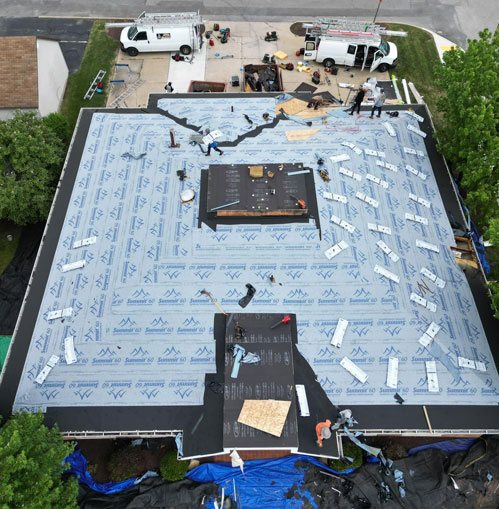
Expansion joints are boring right up until they are not. They sit there doing nothing visible for a decade, and then one January you discover that a quarter-inch of unaccounted movement has opened a 40-foot split in your membrane.
Anyone evaluating Cranberry Township commercial roofing options on a large building should ask directly where the joints are, when they were last inspected, and whether anything has been fastened across them. Understanding how roof expansion joints protect large commercial buildings in Cranberry Township is genuinely one of the highest-leverage things a property owner can learn. Small detail. Enormous consequences.