How do commercial roof walk pads protect high-traffic areas? They act as a sacrificial layer between foot traffic and the roof membrane, absorbing impact from boots, dropped tools, and staged equipment. By funneling technicians onto one defined path, walk pads prevent punctures, abrasion, and premature wear in the zones that see the most activity.
That is the short version. The longer version matters more, because most building owners I talk with underestimate how much traffic their roof actually takes. HVAC service. Exhaust fan repairs. Satellite installers. Holiday lighting crews. Add it up over a year and a "low-traffic" roof starts looking like a sidewalk.
What is a roof walk pad?
A roof walk pad is a thick, textured protective mat installed on top of a finished roof system in areas where people regularly step, kneel, or stage tools. Most are made from reinforced TPO, PVC, or EPDM, and they are typically heat-welded, adhered, or loose-laid depending on the membrane below.
Think of it as armor for the parts of the roof that take a beating. The pad is thicker and denser than the membrane it sits on, so it absorbs the force of a boot heel or a dropped wrench instead of transferring it into the waterproofing layer. Pads usually come in rolls or precut sections, and many include a slip-resistant surface pattern for traction.
Color matters more than people expect. A black pad installed on a white reflective membrane can trap heat and accelerate UV breakdown underneath. A good contractor will match the pad to the roof system rather than grabbing whatever is on the truck.
Why High-Traffic Zones Fail First
Roof failures rarely start in the middle of a wide-open field of membrane. They start at the pinch points. The roof hatch. The ladder landing. The three-foot strip in front of an air handler where a technician kneels twice a season with a tool bag and a pile of sheet metal panels.

Those zones concentrate every risk at once: repeated compression, abrasion from grit tracked in on work boots, and puncture risk from dropped fasteners. A single screw underfoot can open a pinhole. That pinhole does not leak dramatically. It wicks moisture into the insulation quietly for two years until a ceiling tile turns brown and everyone starts pointing fingers.
I have seen roofs under eight years old with visible scuffing and seam stress along the same worn path from hatch to rooftop unit. The rest of the roof looked new. The path looked like a hiking trail.
How Commercial Roof Walk Pads Protect High-Traffic Areas
Protection happens in three ways, and they stack.
First, load distribution. The pad spreads concentrated point loads across a wider surface, which reduces compression on the insulation board and keeps the membrane from stretching over fastener plates.
Second, impact absorption. Dropped tools, hatch covers, and equipment panels hit the pad instead of the waterproofing layer. That alone justifies the cost around any serviced unit.
Third, behavior control. This one is underrated. A visible path tells a stranger on your roof exactly where to walk, which keeps traffic off soft spots, seams, and drain areas. Effective rooftop traffic protection is as much about routing people as it is about the material itself.
What is a roof walkway?
A roof walkway is the full protective route across a roof, not just an individual pad. It connects access points to service points in a continuous, marked path, hatch to unit, unit to unit, unit back to ladder.
Walkways come in a few forms. Adhered or welded membrane pads sit directly on the roof surface. Interlocking rubber pavers rest on the roof and can be lifted for inspection. Elevated metal grating systems raise the path above the membrane entirely, which works well over piping, conduit, or ponding-prone areas.
The right choice depends on traffic volume and roof geometry. A building with two rooftop units and quarterly service needs something very different from a manufacturing facility with weekly rooftop work.
What is a walkway with a roof called?
This one causes confusion, so let us separate the terms. A walkway with a roof over it is generally called a canopy walkway, a covered walkway, or a breezeway when it connects two buildings. In healthcare and campus settings, an enclosed version is often called a pedestrian bridge or a connector.
A roof walkway, by contrast, sits on top of a roof and protects the roof itself. Same words, opposite jobs. If a vendor quotes you a "covered walkway" when you asked about rooftop protection, you are looking at two very different projects and two very different budgets.
Choosing the Right Material
There is no universal best option. There is only the best option for your membrane, your climate, and your traffic pattern.
| Type | Best For | Installation | Considerations |
|---|---|---|---|
| Reinforced TPO/PVC pads | Single-ply roofs with matching membrane | Heat-welded | Strongest bond; must match membrane chemistry |
| EPDM rubber pads | EPDM and modified bitumen roofs | Adhered or loose-laid | Cost-effective; check color compatibility |
| Interlocking rubber pavers | Heavy or frequent equipment traffic | Loose-laid, self-ballasting | Removable for inspection; adds weight |
| Elevated grating walkways | Piping, conduit, ponding areas | Support-mounted | Stays cooler; higher upfront cost |
One practical note: pads are consumables. They wear out. Expect to inspect them annually and replace sections that have curled, cracked, or lost adhesion, especially in freeze-thaw climates.
Where to Install Them
Placement determines whether the investment pays off. Manufacturers increasingly require walkway protection at traffic concentration points as a warranty condition, so this is not purely a maintenance preference.
Prioritize these locations:
- Roof hatches, access doors, and ladder landings
- A service perimeter around every rooftop HVAC unit, ideally three feet wide
- Paths between units that technicians already use
- Approaches to drains, scuppers, and control panels
- Staging areas where parts and tools get set down
Here is my honest advice: walk the roof after a service visit and look for scuff marks. Your technicians will show you the real traffic pattern better than any drawing will. Then install pads where they actually walk, not where you wish they walked.
What is the 25% rule for roofing?
The 25% rule is a building code provision stating that if more than 25% of a roof's total area or roof section is repaired, replaced, or recovered within any 12-month period, the entire roofing system or section must be brought into compliance with current code. It traces back to the International Building Code and its residential counterpart, and adoption varies by jurisdiction.
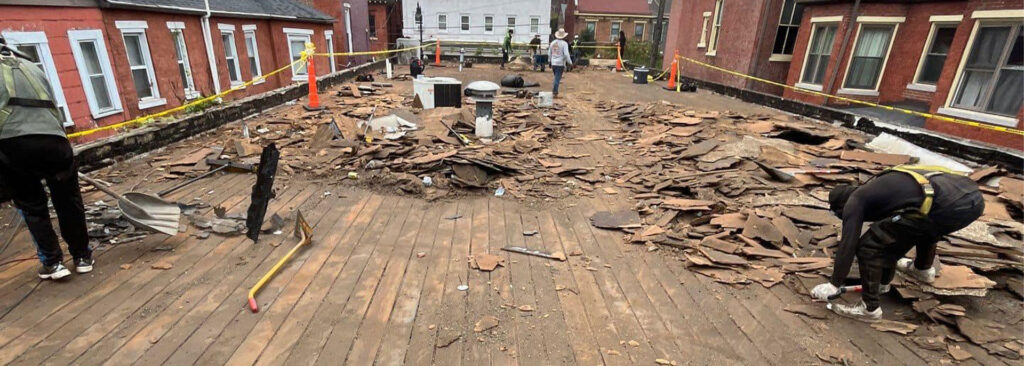
Why does this belong in a conversation about walk pads? Because traffic damage is cumulative and it clusters. Patch a worn hatch area one spring, patch a scuffed HVAC perimeter that fall, then address seam failures along the same path the following year, and you can drift toward a threshold that converts a repair budget into a replacement budget.
Preventing that concentrated damage in the first place is far cheaper than arguing about percentages with a code official. If you are weighing repair against replacement timing, our guide on How Long Does a Commercial Roof Last? breaks down realistic service life by system type.
Mistakes I See Too Often
Pads installed straight to the roof edge. A path should never route someone within a few feet of an unprotected edge, and walk pads are not fall protection. They control roof wear, not gravity.
Pads laid across drainage paths. Block water and you create ponding, which shortens membrane life and voids warranties on some systems. Pads should allow drainage underneath or around them.
Dead-end paths. If the walkway stops short of the unit, people step off it. Protection ends where the pad ends.
Incompatible adhesives. Using the wrong bonding method can damage the membrane you are trying to protect. For a deeper technical breakdown of installation methods and material compatibility, this rooftop walkway protection FAQ from D.C. Taylor Co. is a useful reference.
Making Walk Pads Part of Your Maintenance Program
Walk pads work best as one piece of a documented program rather than a one-time purchase. Pair them with semiannual inspections, a rooftop access log, and a requirement that outside vendors check in before going up.
Consistent commercial roof maintenance turns your roof from a reactive expense into a managed asset. Add photo documentation of the walkway condition to your inspection reports, and you will spot drift, new wear patterns outside the protected route, before it becomes a leak.
The Bottom Line
Roofs do not usually fail all at once. They fail at the places people stand. Well-planned commercial roof walk pads intercept that damage for a fraction of the cost of a premature tear-off, and they make rooftop work safer at the same time.
If your roof sees regular service traffic and has no defined path, that is the gap worth closing this year. Understanding how commercial roof walk pads protect high-traffic areas is the easy part. Getting them placed correctly, matched to your membrane, and folded into a maintenance schedule is where the real savings live.