
I have walked more flat roofs in this city than I can count. A leak shows up in a back office, everyone panics, and by the time I climb up top the real trouble has been brewing for months. So when people ask me what are the most common causes of commercial roof damage in Pittsburgh, I give them the honest answer. It is rarely one dramatic event, just a slow pile-up of small problems that finally gives way.
That is actually good news. Most of what wrecks a commercial roof around here is predictable, and predictable problems can be caught early. In this guide I want to walk you through what I see most often, why our local weather makes it worse, and how to stay ahead of it.
Why Pittsburgh Weather Is So Tough on Commercial Roofs
Pittsburgh does not have the worst weather in the country. What it has is variety, and variety is hard on a roof. We get soaking spring rains, humid summers, and winters that cannot decide whether to snow or thaw. A membrane that would happily last thirty years in a mild climate ages faster here because it never gets to settle. Every season asks it to do something different.
Then there is our terrain. Hills, valleys, and tight city blocks mean wind swirls in odd ways, and shade lingers on parts of a roof long after the rest has dried. Add the flat and low-slope designs most commercial buildings use, and water gets plenty of chances to sit still. Good commercial roofing is really just a system built to move water off fast, and our climate tests that system every week.
A Closer Look at the Most Common Causes of Commercial Roof Damage in Pittsburgh
When I inspect a building, I am usually hunting for four repeat offenders. None of them are exotic. All of them are fixable if you catch them in time. Here is what tends to cause the most roof damage on local commercial properties, starting with the one I flag more than any other.
Freeze-Thaw Cycles and Standing Water
This is the big one. Water pools in a low spot or backs up behind a clogged drain, temperatures drop overnight, and that trapped water turns to ice and expands. By afternoon it melts, then it freezes again, and the cycle pries at seams and flashing a little more each time. Roofers call the pooling “ponding water,” and it is the single most common thing I write up on Pittsburgh roofs. Left alone, a shallow puddle becomes a leak, and a leak becomes a soaked ceiling.
Thermal Shock From Big Temperature Swings
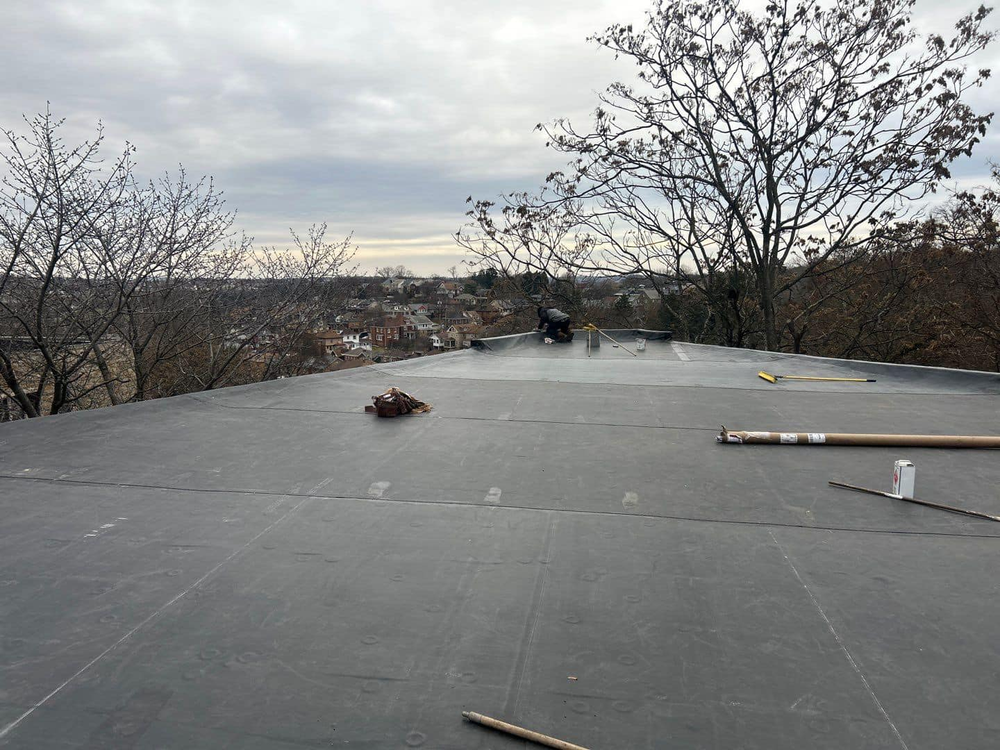
Roofing materials expand when they heat up and shrink when they cool. That is normal. The problem here is how fast it happens. A sunny winter afternoon can warm a dark membrane well above freezing, and then the temperature plunges the moment the sun drops. Do that a few hundred times a year and you get cracking, blistering, and seams that quietly pull loose. I have seen five-year-old roofs that looked ten years older simply because nobody planned for all that stretching.
Foot Traffic and Rooftop Equipment
Commercial roofs are busy places. HVAC units, exhaust fans, satellite gear, and the technicians who service them all live up there. Without walkway pads, every service call means boots grinding grit into the membrane, and a dropped tool can punch a hole straight through. Over time, the busiest paths are the first to fail. They almost never fail where anyone thought to look.
Age, UV, and Everyday Wear
Nothing lasts forever, and sunlight is relentless. Ultraviolet rays slowly bake the flexibility out of a membrane, wind tugs at loose edges, and grit wears down protective coatings year after year. This is the quiet cause. There is no storm to point at, just time adding up until a once-supple roof turns brittle and splits along its weakest seams.
What Is a Common Reason for Roof System Failure in Commercial Buildings?
If I had to name one reason commercial roofs fail early, it would be water that has nowhere to go. Drains clog, slopes are too shallow, and the details around pipes and vents get sloppy. The membrane itself is often fine; the system around it is what breaks down. Poor drainage quietly undermines everything else, which is exactly why I put together a companion piece on What Causes Commercial Roof Drainage Problems in Pittsburgh? if you want to dig deeper on that specific topic.
The other big reason is plain neglect. A roof that never gets inspected hides its problems until they turn expensive. A lifted seam or a cracked boot around a pipe costs almost nothing to fix in spring. Ignore those same details through one Pittsburgh winter and you are suddenly looking at wet insulation, stained ceilings, and sometimes structural repairs.
What Are the Most Common Causes of Roof Damage?
Zoom out from Pittsburgh and the list barely changes. Nationwide, the usual suspects are standing water, high wind, hail and storm debris, foot traffic, blocked drainage, improper installation, and plain old age. What makes our region different is not the cause but the intensity. Freeze-thaw takes a minor drainage flaw and turns it into a yearly demolition crew, so a problem that stays cosmetic in a mild climate becomes urgent here, fast.
What Is the 25% Rule for Roofing?
Here is a term worth knowing before you ever need it. The 25% rule is a building-code guideline: if more than a quarter of a roof, or of a defined roof section, is repaired or replaced within a twelve-month period, that whole section usually has to be brought up to current code. In plain English, small patches can stay small, but once damage crosses that line, a full replacement is often required instead of another quick fix.
The rule started in hurricane-prone states, and it is applied differently from place to place. Around Ohio and much of our region it works more as a guideline that inspectors and insurers lean on than a hard law. Still, it matters for your wallet. If your roof is aging and racking up repairs, a few fixes in one year can quietly push you past the threshold, turning a patch job into a full replacement.
What Is the Average Lifespan of a Commercial Roof?
Most commercial roofs are built to last somewhere between fifteen and thirty years, and the material you choose sets the starting point. Maintenance and climate do the rest. Here is a rough guide to what the common systems deliver when they are installed well and actually looked after.
| Roofing System | Typical Lifespan | What to Know |
|---|---|---|
| TPO (single-ply) | 20–30 years | Reflective surface, heat-welded seams |
| EPDM rubber | 20–30 years | Durable and forgiving in temperature swings |
| PVC | 20–30 years | Strong seams, resists chemicals and grease |
| Modified bitumen | 15–20 years | Budget-friendly but the shortest-lived |
| Built-up (BUR) | 20–30 years | Heavy, multi-layer, tough underfoot |
| Metal | 30–50 years | Longest lifespan, higher upfront cost |
Treat those numbers as ceilings, not promises. A neglected roof in our freeze-thaw climate can lose a full decade off the top of its range, while a well-tended one can quietly outlast it. Industry groups like the National Roofing Contractors Association publish detailed material and maintenance standards if you want to see how professionals benchmark long-term performance.
Simple Ways to Add Years to Your Roof
The cheapest roof is the one you already have, kept in good shape. Consistent roof maintenance is the highest-return decision most building owners can make, and it is not complicated. Twice-a-year inspections, ideally in spring and fall, catch small problems while they are still cheap. Keeping drains and gutters clear stops ponding before winter can weaponize it.
A few habits go a long way. Add walkway pads where crews service your equipment. Clear debris after big storms. Write down what you see so you can spot trends from one year to the next. I tell every client the same thing: a two-hundred-dollar repair caught in October beats a twenty-thousand-dollar surprise in February every single time.
The Bottom Line for Pittsburgh Building Owners
Commercial roof damage in Pittsburgh is rarely bad luck. It is freeze-thaw, standing water, thermal shock, foot traffic, and age, all working together while nobody is watching. The encouraging part is that every one of those responds to attention. A roof that gets inspected regularly and drained properly will shrug off the same winter that destroys a neglected one next door.
So if it has been more than a year since anyone walked your roof, take that as your sign. Get up there, or get a professional up there, before the next hard freeze. Your building, your budget, and your tenants will all thank you for it.