If water is showing up on a ceiling below the middle of your roof rather than along an edge, a valley is one of the first places a roofer will look. Roof valleys leak because they carry more water than any other part of the roof, and anything that interrupts that flow, lifted flashing, worn shingles, packed debris, or ice, sends water sideways and underneath the roofing instead of down into the gutter. Roof valley leak repair is usually a targeted fix rather than a full replacement, but it does need to happen promptly, because the water has a short path to your decking, insulation and drywall.
Pittsburgh roofs are especially hard on valleys. The region's freeze-and-thaw cycles, wet snow, mature tree canopy and older housing stock with complex, steep rooflines all put extra stress on exactly the spot that can least afford it.
What a Roof Valley Is and Why It Matters
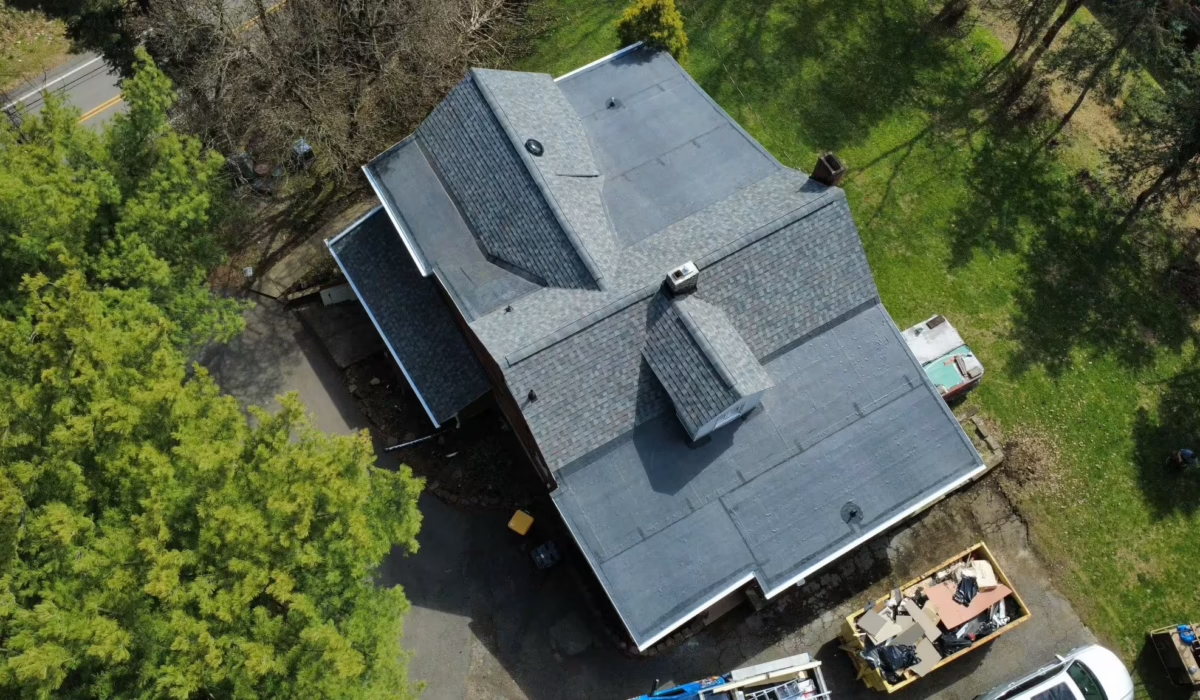
A valley is the internal angle where two roof planes meet, like the crease where a dormer or an addition joins the main roof. Every square foot of water that lands on both of those planes funnels into that single channel. On a house with several gables, dormers or a rear addition, one valley may be draining a third of the roof.
That concentration is the whole story. A shingle in the middle of a roof plane sheds a thin sheet of water. A shingle at the edge of a valley may be hit by a fast-moving stream carrying grit, pine needles and maple seeds with it.
Open vs. closed valleys
Roofers generally build valleys one of two ways. An open valley leaves a strip of metal exposed down the center, with shingles trimmed back on either side. A closed or woven valley carries shingles across the channel so no metal shows.
Both are legitimate approaches and both can fail. Open valleys tend to fail at the metal, corrosion, loose fasteners, or seams that have separated. Closed valleys tend to fail at the shingles themselves, which wear faster in the channel and can crack or lift where they bend over the crease.
Why Roof Valleys Leak in Western Pennsylvania
Ice dams and freeze-thaw
When snow melts on an upper roof plane and refreezes lower down, ice builds up and backs water up under the shingles. Valleys are a natural collection point for that ice. Water that would normally run off in seconds sits there instead, working its way up and under the courses. A stretch of sun, then a hard freeze overnight, then repeat, that cycle is the single most common driver of winter valley leaks around here.
Debris from tree cover
Neighborhoods with mature oaks and maples pay for the shade. Leaves, needles and seed pods wash into valleys and pack at the bottom where the channel narrows. The debris dams the flow, holds moisture against the roofing, and encourages moss along the edges. Over a season or two, that constant dampness breaks down the material underneath.
Flashing problems
Valley metal can rust through, pull loose, or be too narrow for the volume of water it handles. Problems also show up where a valley meets something else, a chimney, a sidewall, a skylight or a gutter. Those transitions are where a lot of leaks actually start, even when the valley itself looks fine from the ground.
Fastener placement and workmanship
Nails driven too close to the center of a valley are a classic source of slow leaks. So is shingle material that was cut short, laid without enough overlap, or installed over an underlayment that did not extend far enough up the channel. These leaks often do not show for years, which makes them frustrating to trace.
Sheer age and water volume
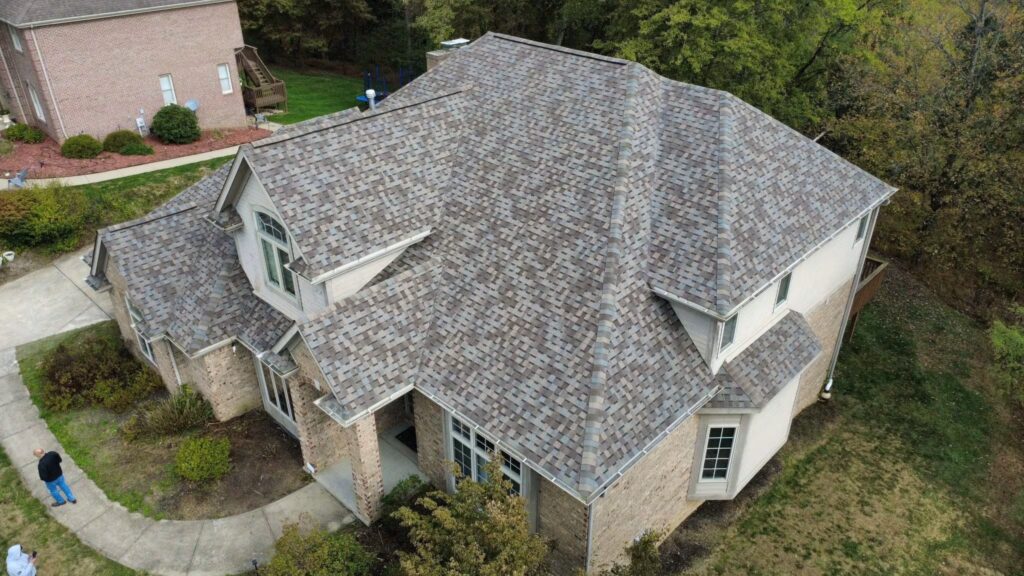
Shingles in a valley simply wear out before the rest of the roof. Granules scour away, the surface thins, and the material becomes brittle. Combine that with gutters that overflow and back water up into the bottom of the valley, and you get failure in the last few feet of the channel.
Warning Signs You May Need Roof Valley Leak Repair
Watch for:
- Ceiling or wall stains that appear in the middle of a room, along an interior wall, or near where a dormer or addition meets the house
- Damp insulation or dark streaks on rafters in the attic, usually uphill from where you see the stain inside
- Granule buildup in gutters, especially below a valley
- Visible debris packed in the channel, or moss growing along its edges
- Rust, dark staining or lifted edges on exposed valley metal
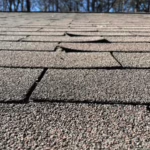
- Cracked, curled or missing shingles where the two roof planes meet
- Icicles and heavy ice buildup concentrated at the bottom of a valley in winter
Water travels along rafters and decking before it drops, so the stain inside almost never sits directly under the hole. That is why tracing a valley leak is worth leaving to someone who can safely get into the attic and onto the roof. If you are seeing any of these signs, it is worth scheduling roof repair in Pittsburgh before the next stretch of freeze-thaw weather.
How Professionals Repair a Leaking Valley
Inspection and leak tracing
A good repair starts with finding the actual entry point, not just the stain. That usually means an attic inspection to follow the water uphill, plus a close look at the valley and every transition it touches. Sometimes a water test is used to confirm the source before anything is opened up.
Cleaning and minor repairs
If the valley is sound and the problem is packed debris, a few loose fasteners or a small section of damaged shingle, the fix can be modest, clearing the channel, resealing seams, and replacing the affected shingles.
Rebuilding the valley
For a failed valley, the common approach is to strip shingles back on both sides, remove the old metal and underlayment, repair any soft or rotted decking, install a self-adhering ice-and-water membrane along the channel, set new valley metal, and reweave or re-trim the shingles. Done well, this is a contained repair that leaves the rest of the roof intact.
Fixing what caused it
A valley that iced up will ice up again unless the underlying cause is addressed. That often means looking at attic insulation and ventilation, gutter capacity, or drainage from an upper roof that dumps directly into the valley. Repairing the symptom without the cause is how homeowners end up paying twice.
When repair is not the answer
If shingles across the whole roof are at the end of their life, or if several valleys and the field are all failing at once, a repair may not be the economical choice. A roofer should tell you plainly when that is the case, and it is worth understanding how to weigh a roof repair against a full replacement before you commit to either one.
Do not Wait on a Valley Leak
Valley leaks rarely stay small. Water that gets under the roofing soaks the decking, then the insulation below it, then the ceiling. Wet insulation stops insulating, and wet framing invites rot and mold. A repair that is straightforward in September can become a much larger job after a winter of freeze-thaw.
Frequently Asked Questions
Can a roof valley be repaired without replacing the whole roof?
In most cases, yes. If the surrounding shingles still have life left, a valley can be rebuilt on its own.
How long does a valley repair take?
Many are completed in a day, though the scope depends on the length of the valley and whether decking underneath needs replacing.
Why does my ceiling stain appear far from the valley?
Water runs along framing before it drips. The visible stain is where it finally fell, not where it entered.
Should I clean debris out of my own valleys?
Not from a ladder or from the roof itself. Valleys are slick, often steep, and sit well up the roof plane. Ask a roofer to clear them during an inspection.
Get the Valley Looked At Before Winter
If you have seen stains, icicles piling up in one spot, or debris packed where two roof planes meet, have it inspected. Malick Roofing works on homes throughout Pittsburgh and Western Pennsylvania, and a valley inspection is a short visit that can save you a much larger repair. Contact us to schedule a look at your roof.
Malick Brothers Exteriors offers roofing, gutters, siding, and more across Pittsburgh and Southwest PA. Explore our services to get started.