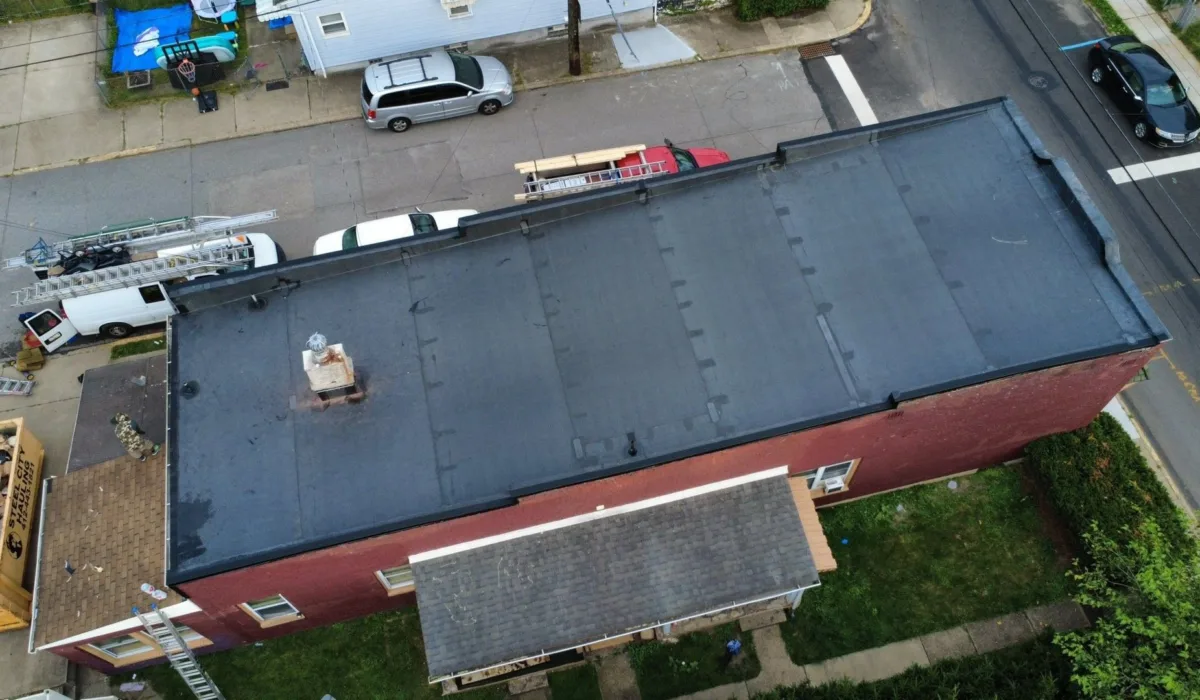
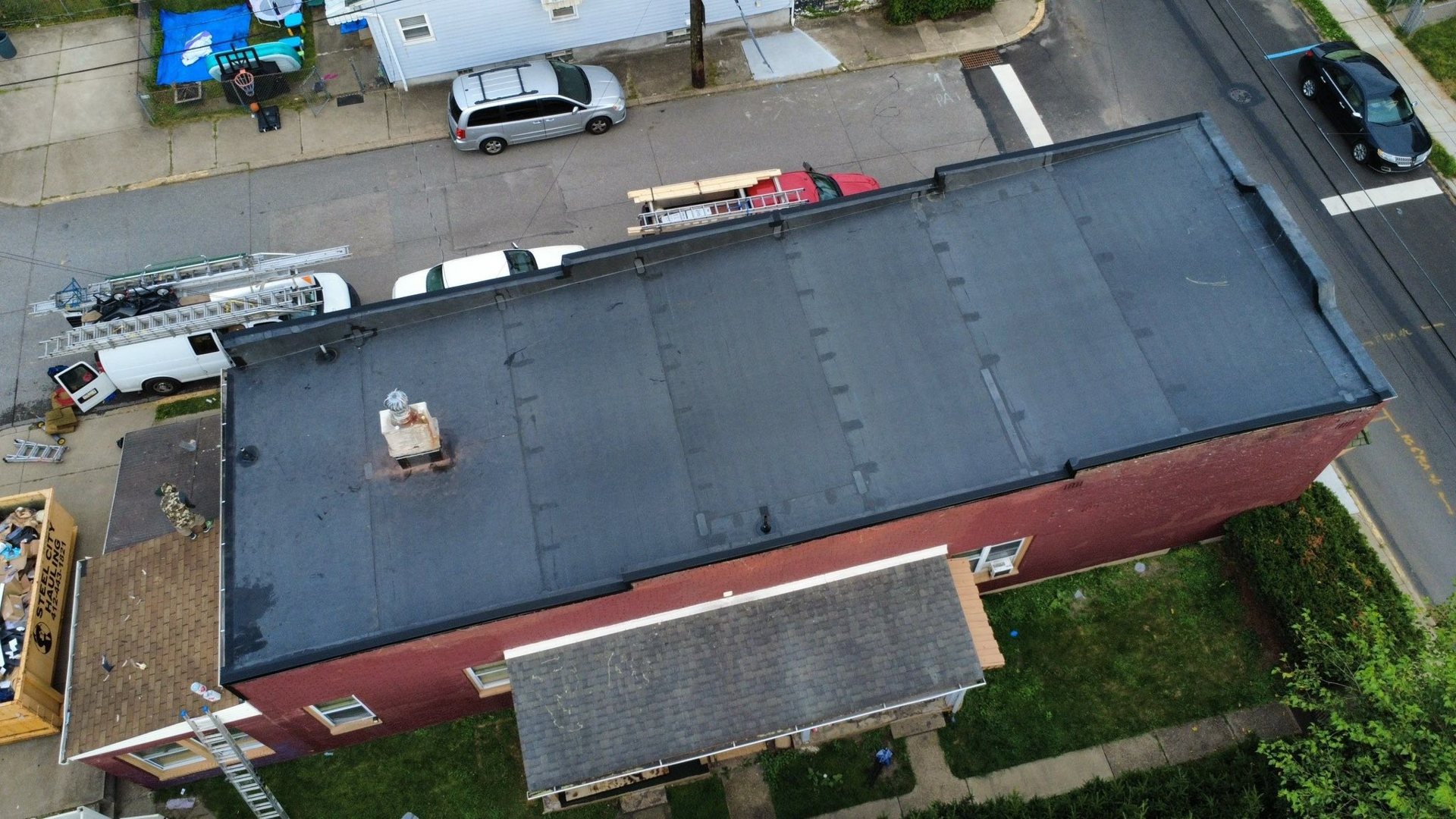
A membrane roof is a continuous waterproof sheet that covers a flat or low slope roof. Shingles shed water by overlapping, which only works when the roof is steep enough for water to run off quickly. A flat roof holds water longer, so it needs a sealed surface with as few seams as possible. That sealed surface is the roof membrane.
In Pittsburgh, membrane roofing covers far more than warehouses. It is on row houses, porch roofs, rear additions, dormers, garages, apartment buildings and storefronts across the city and the North Hills. We are MuleHide certified, and most of the flat roofs we install are EPDM rubber roofing or a 2 ply low slope system. This guide explains the membrane types, how long they last, their real drawbacks and how to tell which one fits your building.
What Is a Membrane Roof?
A membrane roof is a roofing system built around large flexible sheets instead of small overlapping pieces. The sheets are rolled out over insulation or a cover board, attached to the roof deck, and joined at the seams with adhesive, seam tape or heat welding. The finished roof works like a liner: water sits on top of it until it reaches a drain, scupper or gutter.
A complete membrane roofing system has more parts than the sheet itself:
- Roof deck: the wood, steel or concrete structure underneath.
- Insulation or cover board: rigid boards that add R value and give the membrane a smooth base. Tapered insulation can also create slope toward the drains.
- The membrane: the waterproof layer.
- Flashing: membrane and metal details at walls, parapets, chimneys, pipes, skylights and roof edges. Most flat roof leaks start at flashing, not in the open field of the roof.
- Drainage: interior drains, scuppers, gutters or box gutters that carry the water away.
Why Flat and Low Slope Roofs Need a Membrane
Asphalt shingles are not designed for roofs flatter than a 2:12 pitch, which is 2 inches of rise for every 12 inches of run. Below that pitch, wind and ice can push water uphill under the shingle laps. Shingle manufacturers and building codes do not allow shingles there, and a shingled low slope roof is one of the most common causes of the leaks we are called to fix.
Pittsburgh weather makes this worse. Snow sits on a flat roof, melts during the day and freezes again at night. That cycle works water into every lap and nail hole. A membrane has no laps for water to climb, so it is the correct answer on low slope sections. Many homes here need both materials: shingles on the main roof and a membrane on the porch, dormer or rear addition. On a Mt. Washington home in April 2025 we installed Atlas shingles on the steep slopes and MuleHide .060 EPDM on the low slope section, tied together as one roof.
Flat Roof Membrane Types Compared
There are five membrane roofing systems you will hear about. Three are single ply sheets (EPDM, TPO and PVC) and two are asphalt based systems built up in layers (modified bitumen and built up roofing).
| Membrane | What it is | How seams are sealed | Best fit | Main drawback |
|---|---|---|---|---|
| EPDM | Black synthetic rubber sheet | Seam tape and primer or adhesive | Homes, garages, apartments, small and mid size commercial roofs | Black surface absorbs heat |
| TPO | White reflective thermoplastic sheet | Hot air welded | Large commercial roofs where cooling load matters | Shows dirt; newer material with a shorter track record |
| PVC | White thermoplastic sheet | Hot air welded | Restaurants and buildings with grease or chemical exhaust | Usually the most expensive single ply |
| Modified bitumen | Asphalt sheets modified with rubber or plastic, installed in 2 plies | Adhesive, self adhering sheets or heat | Small roofs, porches, roofs with foot traffic | More seams than a wide single ply sheet |
| Built up roofing (BUR) | Alternating layers of felt and hot asphalt, often topped with gravel | No seams; layers are mopped together | Older commercial buildings | Heavy, slow to install and hard to trace leaks under gravel |
EPDM rubber membrane
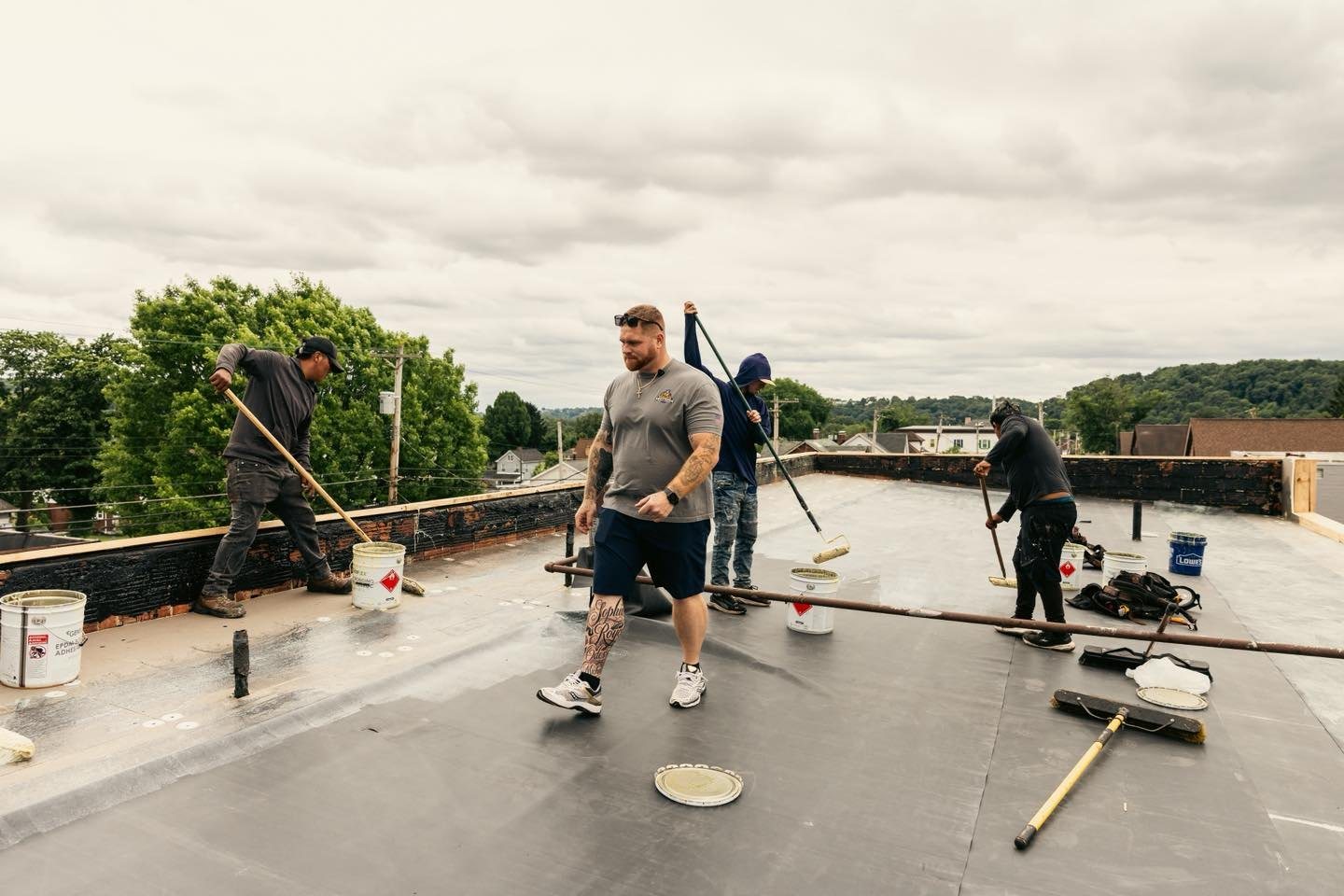
EPDM (ethylene propylene diene monomer) is a synthetic rubber that has been used on low slope roofs in the United States for decades. The EPDM Roofing Association describes it as an extremely durable membrane, and its record in cold climates is the reason we use it so often. It stays flexible in freezing weather, handles hail well, and comes in wide sheets, so a porch or garage can often be covered with no field seams at all.
EPDM is sold in two common thicknesses, 45 mil and 60 mil. We install the thicker .060 (60 mil) MuleHide membrane. It can be fully adhered, mechanically attached or ballasted. With good installation and basic maintenance, EPDM roofs commonly last 25 to 30 years.
TPO membrane
TPO (thermoplastic polyolefin) is a white single ply sheet with seams that are welded together with hot air. The white surface reflects sunlight, which helps reduce cooling costs on large air conditioned buildings. It resists mold and punctures. The drawbacks are that it shows dirt, and that it is the newest of the common membranes, so it has less long term history than EPDM or PVC.
PVC membrane
PVC (polyvinyl chloride) is also white and heat welded. Its advantage is chemical resistance. Grease from a restaurant exhaust fan will break down many roofing materials, but PVC holds up to it, and it has high fire resistance. It is normally chosen for that specific need.
Modified bitumen and 2 ply systems
Modified bitumen is asphalt that has been blended with rubber or plastic modifiers and reinforced with a mat. It is installed as a base sheet and a cap sheet, which is why it is called a 2 ply system. Two layers give redundancy, and the granule surface stands up to foot traffic. We used a MuleHide 2 ply low slope system on an Observatory Hill home in April 2025, alongside new Atlas shingles on the steep slopes.
Is a Membrane Roof Right for Your Pittsburgh Building?
If any part of your roof is flatter than 2:12, the answer is yes for that section. The better question is which membrane. This is how we usually think about it:
- Row houses and homes with a flat main roof (common in Lawrenceville, Bloomfield, the South Side and the North Side): EPDM, fully adhered, with new flashing at the parapet walls.
- Porch roofs, dormers and rear additions: EPDM or a 2 ply system, tied in under the shingles above.
- Garages and outbuildings: EPDM is durable and cost effective here, and the heat a black roof absorbs matters less over unconditioned space.
- Apartment buildings and storefronts: EPDM is the standard choice. A white thermoplastic membrane is worth comparing on a large air conditioned building.
- Restaurants: PVC near grease exhaust.
- An older flat roof that is worn but still dry and sound: a silicone roof coating can sometimes extend its life without a tear off.
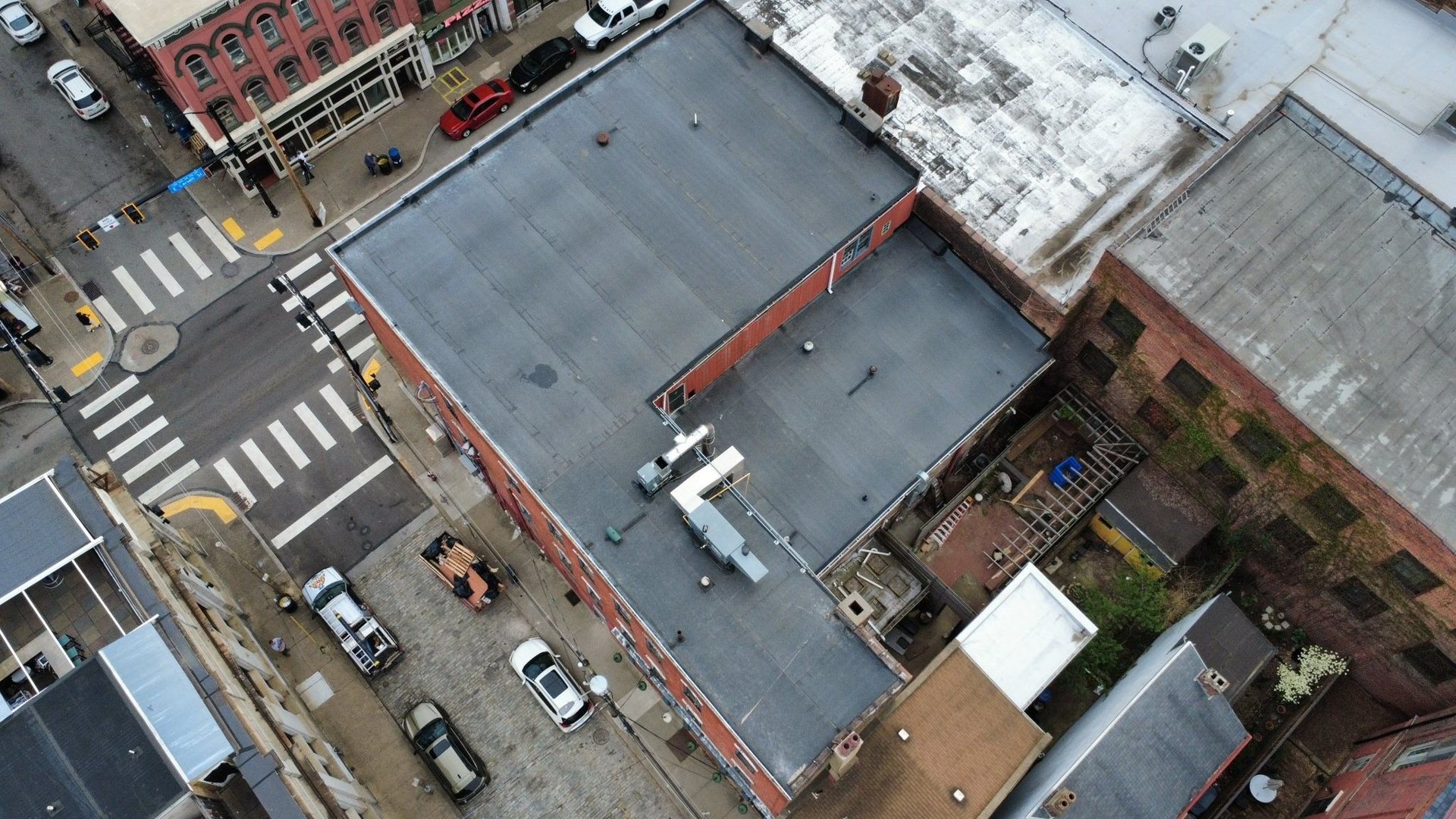
Two of our recent commercial roofing jobs show the typical case. In April 2025 we installed a MuleHide .060 EPDM roof for Pittsburgh Mirror and Glass, and in June 2025 we installed an EPDM roofing system on an apartment building in McKees Rocks. Both are occupied buildings where the owner needed a long lasting roof with little upkeep.
Disadvantages of a Membrane Roof
No roofing material is perfect, and you should hear the drawbacks from a roofer before you sign anything.
- Punctures: a single ply membrane can be cut by dropped tools, sharp branches or careless work around rooftop equipment. Walk pads solve this where people need regular access.
- Seams and flashing are the weak points: the sheet itself rarely fails. Leaks come from poorly sealed seams, pipe boots, drains and wall flashing. Installer skill matters more than brand.
- Heat: black EPDM absorbs heat. Proper insulation under the membrane is what keeps the rooms below comfortable.
- Ponding water: any flat roof that holds water for days will age faster. Drainage has to be corrected when the roof is replaced, not ignored.
- Repairs need the right materials: roofing tar and asphalt products damage EPDM. Repairs must use compatible primer, tape and patches.
How Long Does a Membrane Roof Last?
Lifespan depends on the material, the thickness, the installation and the drainage. As a general guide, a well installed EPDM roof commonly lasts 25 to 30 years, TPO and PVC roofs 20 to 30 years, and a 2 ply modified bitumen roof about 20 years. A thicker membrane, a fully adhered installation and good drainage all push a roof toward the long end of its range.
Maintenance is simple but it matters:
- Clear leaves and debris from drains, scuppers and gutters every spring and fall.
- Look at seams, pipe boots and wall flashing once a year and after major storms.
- Keep tree limbs trimmed back from the roof.
- Have any small split or open seam repaired right away, before water reaches the insulation.
If you are not sure what condition your flat roof is in, a roof inspection will tell you whether it needs a repair, a coating or a replacement.
What Drives the Cost of a Membrane Roof?
We do not publish prices because two flat roofs of the same size can be very different jobs. These are the factors that move the number on a written estimate:
- Tear off: how many old layers are on the roof and what they are made of.
- Deck condition: rotted wood under an old leak has to be replaced.
- Insulation: the thickness required and whether tapered insulation is needed to fix ponding.
- Membrane type and thickness: for example, 60 mil EPDM compared with 45 mil.
- Penetrations and edges: every pipe, skylight, chimney, HVAC curb and parapet wall adds flashing work.
- Access: a third floor row house roof on a narrow street takes more labor than a one story garage.
We measure the roof, check the deck and drainage, and give you a free written estimate that lists exactly what is included.
Choosing a Flat Roof Contractor in Pittsburgh
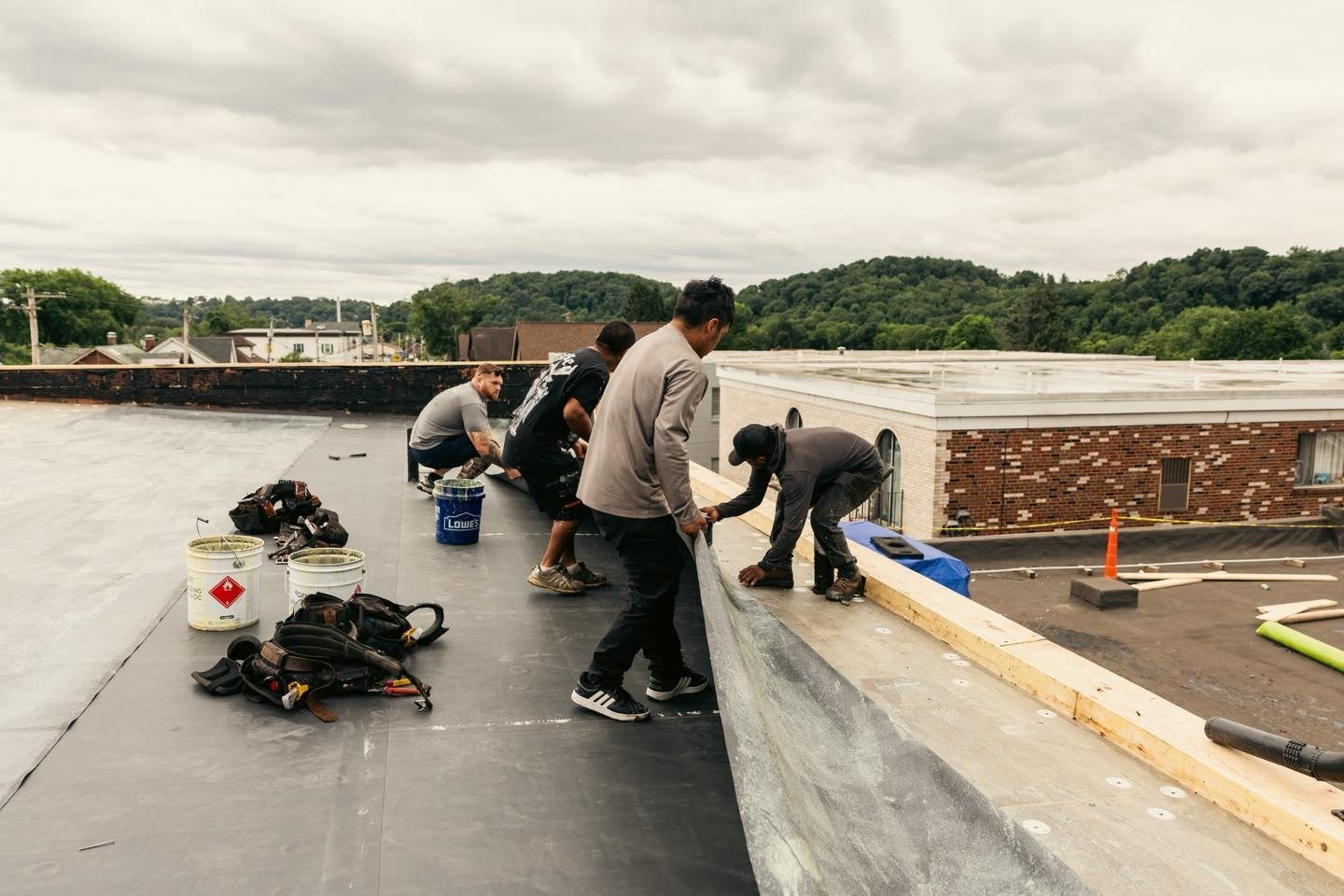
Flat roofing is a different trade from shingle roofing, so ask direct questions. Is the contractor certified by the membrane manufacturer? Will the roof be fully adhered or mechanically attached, and why? How will ponding areas be corrected? What happens at the walls, drains and edges? Can you see photos of their own completed flat roofs?
Malick Brothers Exteriors is a family owned company founded in 2022 by Ryan Malick, with our shop at 500 Perry Highway in West View. We are certified by MuleHide for EPDM, 2 ply low slope systems and silicone coatings, BBB A+ accredited, and registered as a Pennsylvania home improvement contractor (PA174918). Our repair division also handles flat roof and box gutter repairs when a full replacement is not needed.
Membrane Roofing FAQ for Flat Roofs
What is the best membrane for a flat roof?
There is no single best membrane. For most Pittsburgh homes, garages, apartment buildings and small commercial roofs, 60 mil EPDM is the choice we recommend because it handles freeze and thaw cycles and has a long track record. A white TPO or PVC membrane can be the better fit on a large air conditioned building or a restaurant with grease exhaust.
Can you put a membrane roof on a house?
Yes. Membrane roofing is used on houses all over Pittsburgh, including row houses with a flat main roof and homes with a low slope porch, dormer or addition. The membrane goes on the low slope section and ties in under the shingles on the steeper slopes, so the whole roof works as one system.
Can a membrane roof be installed over an existing roof?
Sometimes. If the existing roof is dry, firmly attached and there is only one layer, a new membrane can occasionally go over it with a cover board. If the insulation is wet or the deck is soft, the old roof has to come off. We check for trapped moisture and deck damage before we recommend either approach.
How do I know if my flat roof needs to be replaced?
Common signs are open or lifting seams, membrane pulling away from walls, soft spots underfoot, water that stays on the roof for more than two days, and stains on the ceilings below. One isolated leak can usually be repaired. Widespread seam failure or wet insulation normally means replacement is the better use of your money.
Get a Free Flat Roof Estimate
If you have a flat or low slope roof in Pittsburgh or the North Hills and want a straight answer about which membrane fits it, contact Malick Brothers Exteriors. We will inspect the roof, explain your options and give you a free written estimate.