Is TPO roofing good for cold climates like Pittsburgh? The short answer is yes, with conditions. A quality TPO membrane that is welded correctly and sits on dry, well fastened insulation will come through Pittsburgh winters. The longer answer is that the conditions matter more here than they do in a mild climate, because freeze and thaw cycles, wet snow loads and cold weather installation windows all test the parts of a TPO roof that fail first: the seams, the flashings and the installer. That is why most of the low slope roofs we put on in the North Hills and across the city are EPDM roofing or a MuleHide 2 ply system rather than TPO. This post explains what TPO does well in a Pittsburgh winter, where it struggles, how cold weather changes the seam welding, and the cases where TPO is still the right membrane for a building.
For a side by side on every point, read our EPDM vs TPO comparison for Pittsburgh businesses. This article stays on one question: how TPO behaves in the cold.
What a Pittsburgh Winter Asks of a Flat Roof
Pittsburgh does not get the deep, dry cold of the northern plains. It gets something harder on a membrane: temperatures that cross the freezing line again and again from November through March. Snow falls, a mild afternoon melts the top layer, the water runs to a frozen drain, and that night it freezes again. Every cycle works at the seams and pushes ice into any opening in a flashing.
A low slope roof here has to stay flexible well below freezing, hold ice and standing water at the drains without the seams lifting, and carry wet snow without the insulation crushing. TPO and EPDM both can meet those demands. They do it in different ways, and the differences show up most in the cold.
Where TPO Roofing Is Strong in Cold Weather
TPO is a thermoplastic sheet, usually white, with seams joined by hot air welding. The welded seam is the biggest strength of the system. Welded correctly, the two sheets fuse into one piece of plastic as strong as the field of the membrane, and ice at a drain, ponded water and wind uplift have no adhesive layer to attack.
Other points in favor of TPO on a Pittsburgh building:
- Reinforced TPO resists punctures from wind blown debris and from foot traffic around rooftop units in winter when the surface is slick.
- TPO sheets come in wide rolls, so a large open roof has fewer seams in total.
- Welded flashings around curbs and pipes are strong and repeatable when the crew is trained.
- Where a building runs heavy air conditioning in July and August, the white surface lowers the roof temperature and the cooling load.
Where TPO Struggles in Freeze and Thaw
The weaknesses of TPO in a cold climate come from the same chemistry that gives it the welded seam. TPO is a plastic, and plastics stiffen as they get colder. Better membranes keep more of their flexibility at low temperatures; lower grade sheets get hard enough in a January cold snap that a sharp bend, a loose fastener head or a dropped tool can crack them. Membrane quality is not visible from the ground, so the brand and grade on the quote matter.
The second issue is thermal movement. A TPO roof swings from well below freezing on a clear night to well above it in afternoon sun, and the sheet expands and contracts with every swing. Over years that pulls at the welded seams and at the terminations along walls and curbs. Where a weld was cold or an edge was not secured, winter is when it opens.
The third issue is that TPO does not stretch much. EPDM rubber elongates several times its length and comes back; scrim reinforced TPO has far less give. That is fine on a rigid steel deck. On an older Pittsburgh building with a wood deck that moves or a masonry wall that heaves each winter, the transitions show stress first.
Seam Welding in Cold Weather
This is the part building owners rarely hear about, and it decides whether a TPO roof installed between November and March lasts. Hot air welding heats two sheets until the plastic flows, then presses them together with a roller. The weld depends on the air temperature from the welder, the speed it travels, and the temperature of the membrane itself.
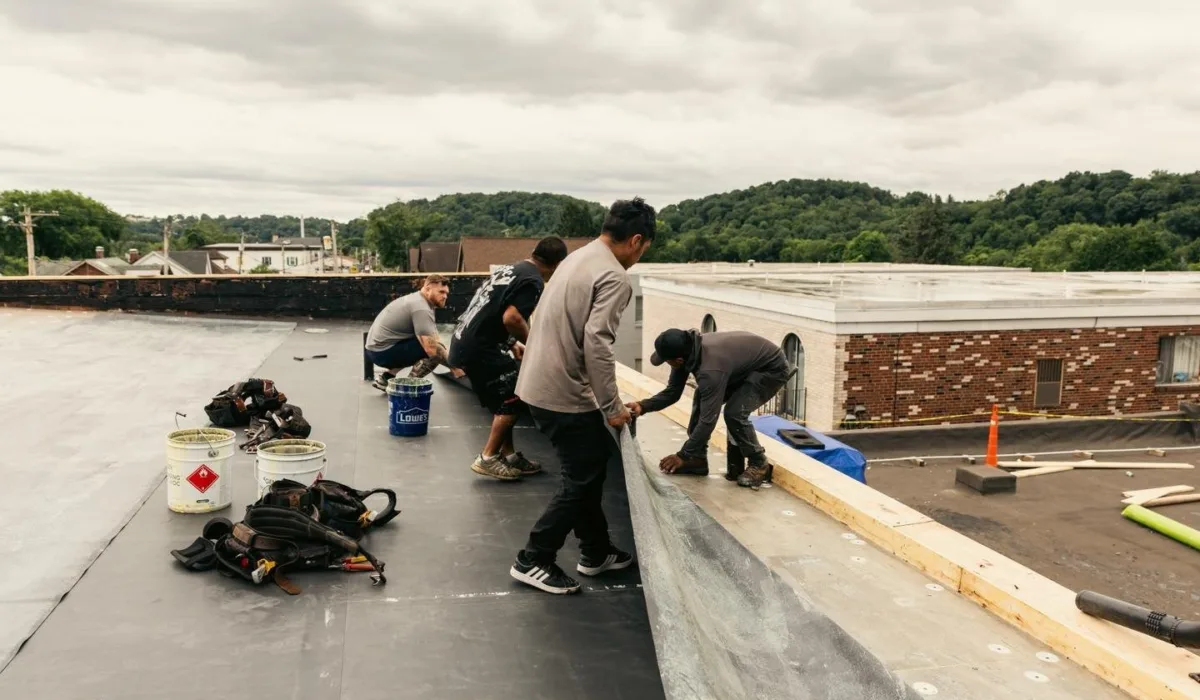
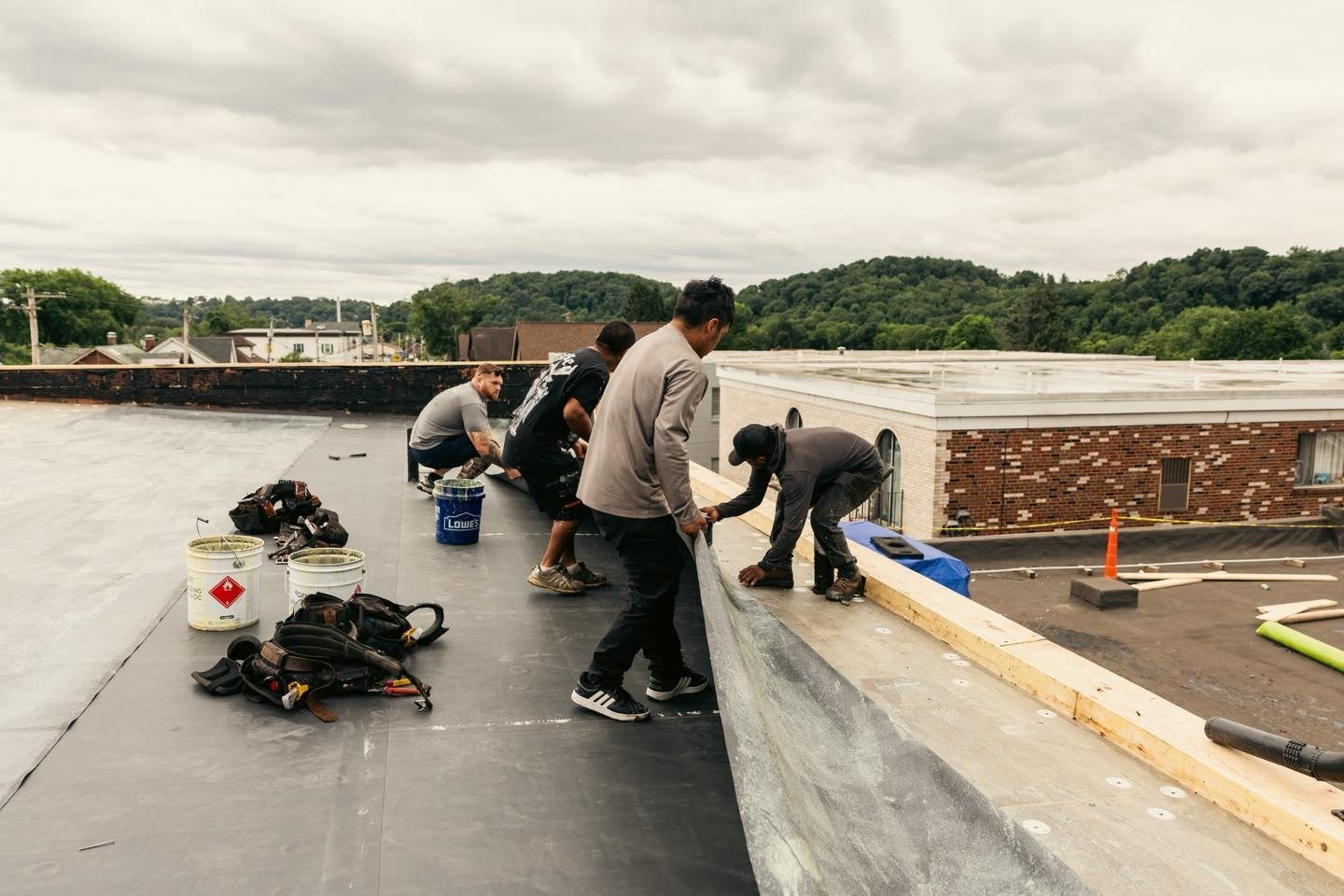
In cold weather the membrane is a heat sink. It pulls heat out of the weld zone faster than it does in June, so the welder setting that made a perfect seam in summer makes a cold weld in winter. A cold weld looks closed and passes a visual check, then peels apart after a few seasons of freeze and thaw. Crews that do this work know the fix: slow the welder, raise the air temperature, keep the membrane warm before welding, and cut test strips at the start of every shift and whenever the weather changes to confirm the sheet tears before the seam does. Wind cools the weld zone instantly, so exposed roofs often need wind screens.
Bonding adhesives and insulation have their own cold weather limits. Any single ply membrane can be installed in a Pittsburgh winter by a crew that respects them. TPO simply leaves less room for error, because the seam is either welded correctly or it is not, and you cannot tell by looking. Mule-Hide, the manufacturer whose systems we install, publishes its TPO membrane line alongside its EPDM membranes, and any contractor should be able to show you the installation requirements before work starts.
Why We Install MuleHide EPDM and 2 Ply Systems
We have been MuleHide certified since February 2023 and install MuleHide .060 EPDM, the MuleHide 2 ply low slope system, and MuleHide silicone coatings over sound existing roofs and box gutters. We made that choice for Pittsburgh conditions.
EPDM is a synthetic rubber. It stays flexible far below any temperature Pittsburgh produces, it stretches over a deck that moves, and its black surface warms in winter sun and sheds snow and ice faster than a white roof. The .060 thickness we use is thicker than the 45 mil rubber sold at home centers and stands up better to foot traffic and hail. Seams are made with factory tape and primer, a forgiving process in cold weather when the crew conditions the materials, and a tape seam can be resealed on a later service visit without a welder. The trade off is that an EPDM seam is an adhesive joint rather than a fused one, so it needs clean work and a periodic look. We accept that trade because the rest of the membrane suits freeze and thaw so well.
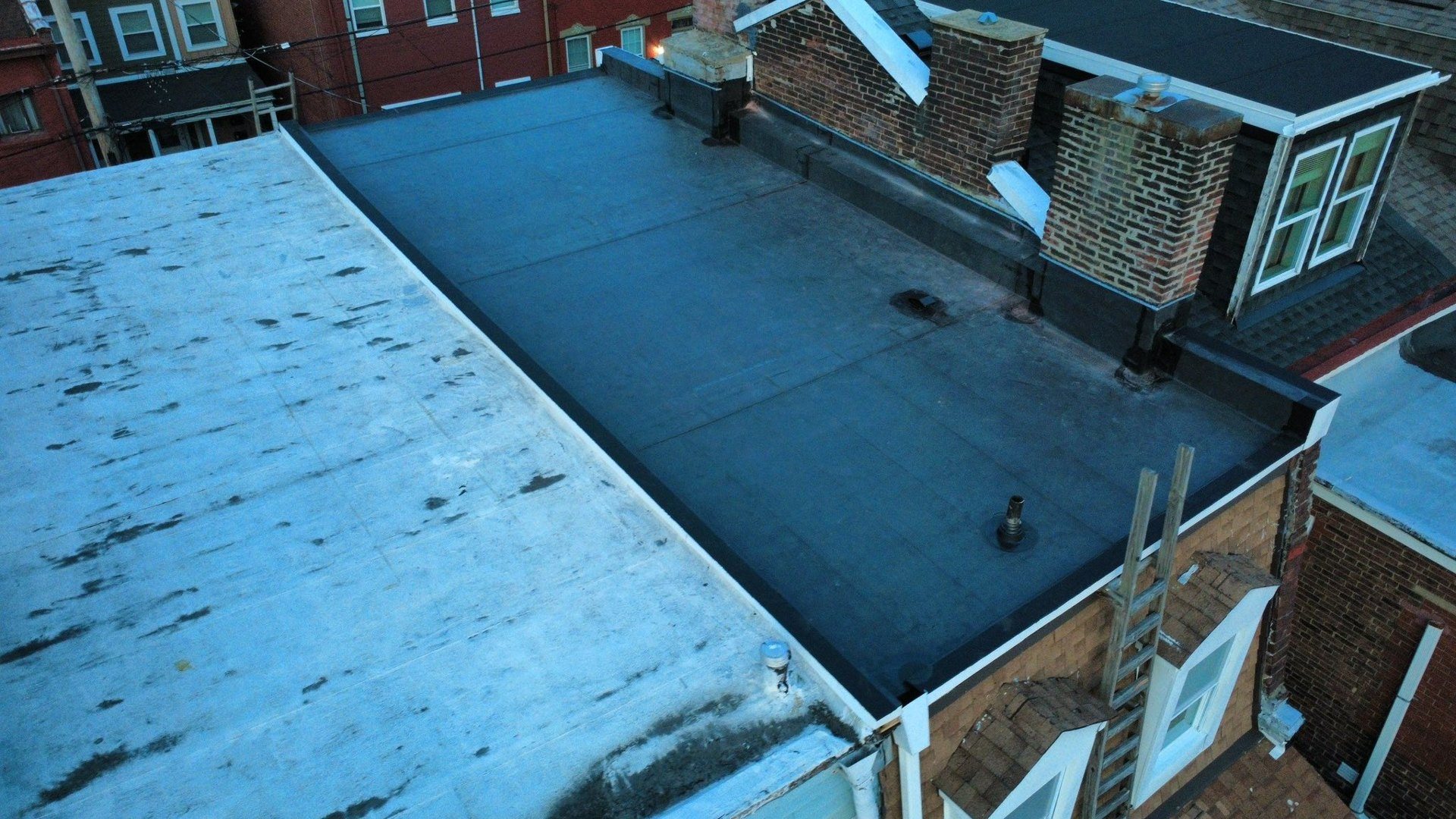
The 2 ply system is a modified bitumen assembly, a base sheet and a granulated cap sheet, and it is what we recommend on roofs that take abuse: heavy foot traffic around mechanical units and roofs where a single sheet has been punctured repeatedly. Two plies mean redundancy, and the granule surface takes impact that would mark a single ply.
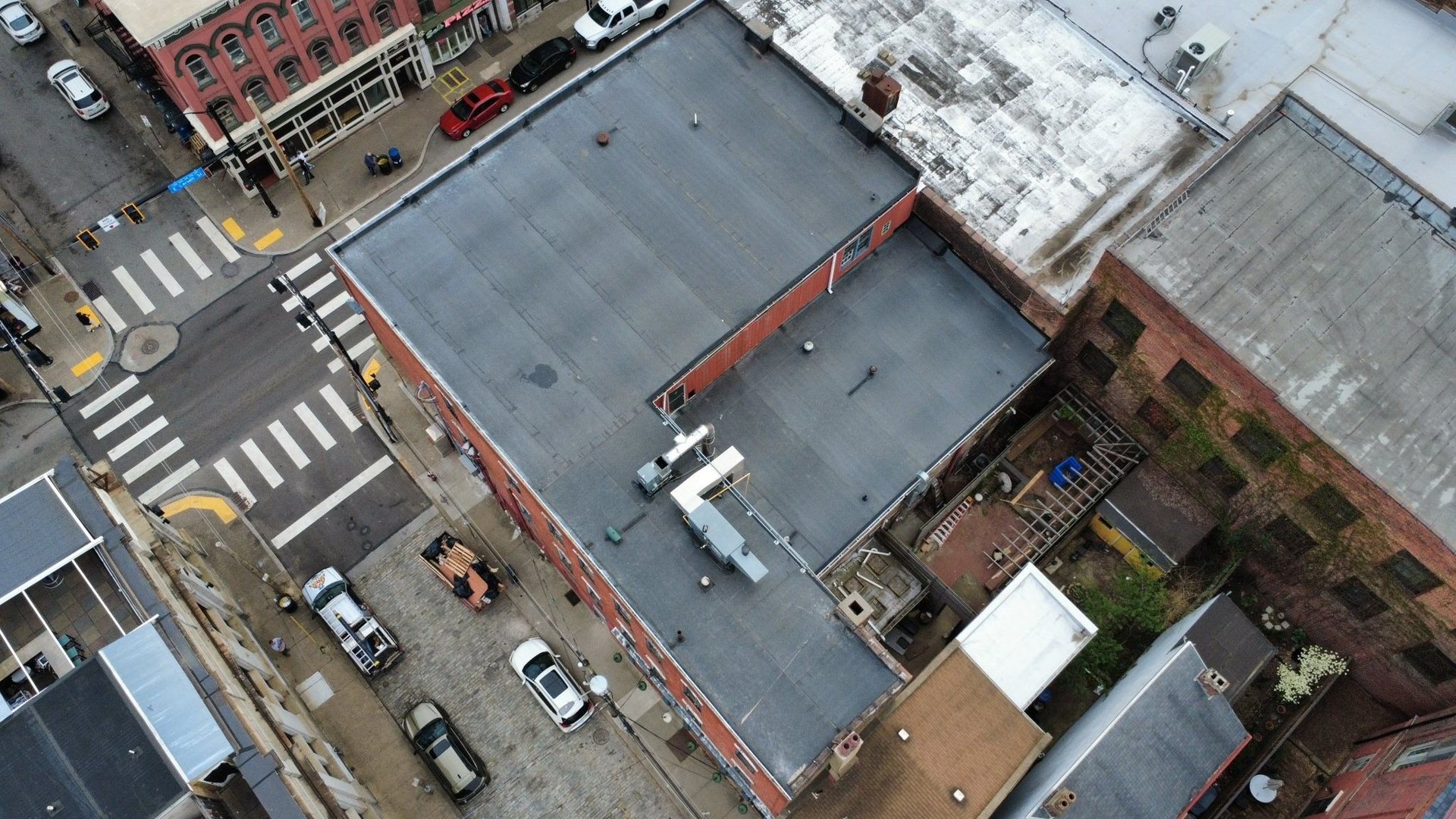
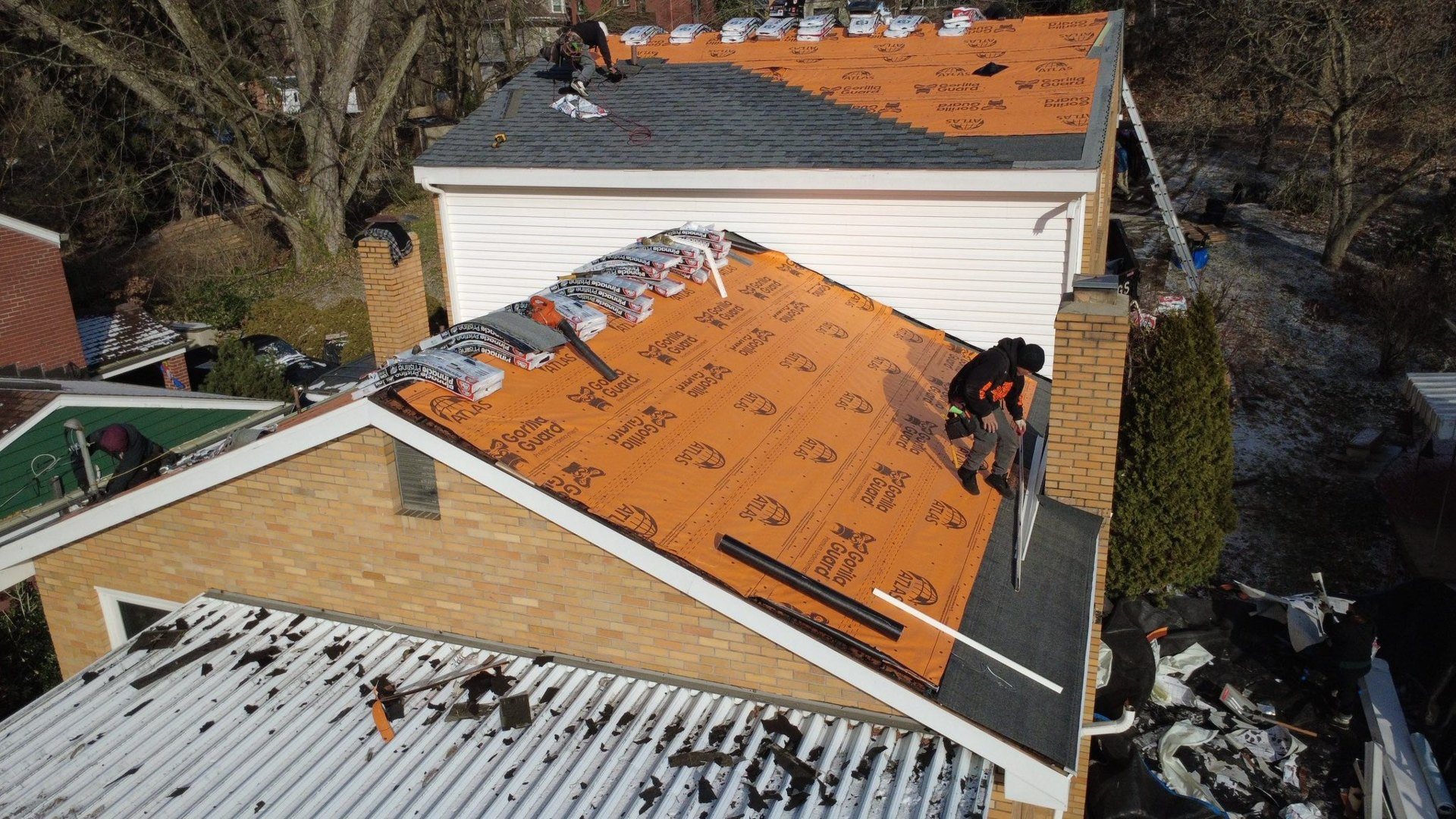
In 2025 we installed MuleHide .060 EPDM on the Pittsburgh Mirror and Glass building, an EPDM system on an apartment building in McKees Rocks, a MuleHide 2 ply low slope system with an Atlas shingle roof in Observatory Hill, and EPDM on the low slope section of a Mt. Washington home. See more on our commercial roofing page.
When TPO Is Still the Right Call
Rubber is not always the answer. There are Pittsburgh buildings where TPO is the better membrane, and if yours is one of them we will say so during the free estimate.
- Roofs crowded with equipment and penetrations. Welded flashings around dozens of curbs, pipes and conduit supports are stronger and faster to make than taped rubber flashings.
- Buildings with a large summer cooling load. A big box store or distribution center that runs rooftop units all summer gets real value from a white reflective surface, and winter heat loss through a well insulated roof is small by comparison.
- Matching an existing TPO roof. When one section already has sound TPO, keeping one membrane type keeps the tie in simple and the manufacturer warranty intact.
- A cool roof requirement. Some lenders, energy programs and tenants specify a reflective roof. White TPO meets it directly.
- Chemical or grease exposure. Restaurant exhaust and some industrial discharge degrade rubber faster than thermoplastic.
In each case the same rule applies: specify a reinforced membrane from a major manufacturer, insist on a crew with cold weather welding experience, and ask for test welds if the job runs in winter.
TPO Roof Repair in Pittsburgh
If you already own a TPO roof, the question is how to keep it working. Most winter leaks on TPO roofs around Pittsburgh come from a seam that was never fully welded, a wall or curb flashing that thermal movement pulled loose, a drain or scupper where ice backed water over a seam, or a puncture from dropped tools or dragged equipment.
A TPO repair done right is a welded patch of the same membrane. Tape patches and caulk along a seam are short term at best. Our repair division handles flat, rubber and single ply roofs, and the first step on any flat roof leak is a roof inspection that traces the water to its entry point, which is often far from the stain inside.
What Drives the Cost of a Low Slope Roof Here
The membrane is usually a smaller share of the total than owners expect. The bigger drivers are deck condition, how much wet insulation has to come out, the number of penetrations and curbs, drainage corrections, edge metal, and whether the job runs in a winter window. We put all of that in a free written estimate you can compare line by line with any other quote. Financing is available.
Frequently Asked Questions
What are the downsides of TPO roofing?
TPO stiffens in cold weather, and lower grade sheets can crack when they are cold and bent or struck. It expands and contracts with temperature swings, which stresses seams over the years. It does not stretch much, so it suits rigid decks better than old wood decks that move. And the welded seams depend entirely on the installer, since a cold weld is invisible until it fails.
Can TPO be installed in cold weather in Pittsburgh?
Yes, by a crew that adjusts for it. Winter welding needs slower welder speed, higher air temperature, wind protection and test welds at the start of each shift. Adhesives and insulation have minimum temperature and dryness limits as well. The membrane itself is not the problem in winter; the installation process is where cold weather causes failures.
Can TPO go directly on plywood?
Not by itself. Single ply membranes go over insulation or a cover board fastened to the deck. TPO laid straight on plywood lets the deck seams telegraph through, traps moisture against the wood and voids most manufacturer warranties. The same applies to EPDM. A proper assembly is deck, insulation, cover board, then membrane.
How long does a TPO roof last in Pittsburgh?
A reinforced TPO roof from a major manufacturer, installed with sound welds and kept clear at the drains, should give twenty years or more here. A lower grade sheet or a roof with cold welds can open at the seams in far less time. Annual inspection and prompt welded repairs decide which outcome you get.
Is EPDM or TPO better for a Pittsburgh winter?
For most buildings here, EPDM, because rubber stays flexible in the cold, stretches with the building and sheds snow faster. TPO wins on roofs with heavy equipment, large cooling loads, cool roof requirements or grease exposure. Our EPDM vs TPO comparison goes through every point in detail.
Does Malick Brothers install TPO?
Our low slope systems are MuleHide .060 EPDM, the MuleHide 2 ply system and MuleHide silicone coatings, because they fit Pittsburgh conditions best. We inspect and advise on TPO roofs, and when a building is a true TPO case we say so in the estimate.
Get a Straight Answer on Your Flat Roof
Malick Brothers Exteriors is family owned, BBB A+ accredited, PA HIC PA174918 and MuleHide certified, with a shop at 500 Perry Highway in the North Hills. If you want to know whether TPO, EPDM or a 2 ply roof is right for your building, contact us for a free inspection and written estimate.