Table of Contents
Edge metal matters on commercial roofing systems in Leetsdale because the perimeter is where wind uplift hits hardest and where most roof failures start. Properly designed and fastened edge metal locks down the membrane, directs water away from the wall, and stops a strong gust from peeling back an entire roof assembly.
That answer surprises a lot of building owners. When people picture a roof failing, they picture a hole in the middle of the field. In my experience, that almost never happens first. The trouble starts at the edge, works its way inward, and by the time anyone notices water in the building, the damage is already expensive.
What is edge metal in roofing?
Edge metal is the formed sheet metal that terminates and secures a low-slope roof at its outer boundary. It sits where the roof membrane meets the exterior wall, parapet, or fascia line. Its job is threefold: hold the membrane down, direct water off the roof, and cover the raw termination so nothing works loose over time.
On a typical commercial building around here, edge metal is fabricated from aluminum, galvanized steel, stainless, or copper. It usually includes a continuous cleat, a fascia or coping face, and a hemmed drip that kicks water clear of the wall. None of it is decorative. Every bend and every fastener has a structural reason for being there.
What is the metal edge of a roof called?
Depending on the assembly, the metal edge is called a gravel stop, a drip edge, a fascia system, or a coping cap. Gravel stop and drip edge refer to the low-profile trim at a flat roof’s termination. Fascia describes the taller vertical face that wraps the building’s perimeter band.
Coping is different. Coping caps the top of a parapet wall, covering it on both sides so water can’t sit on the wall assembly. If your building has a raised parapet, coping is the piece doing the heavy lifting. Contractors will sometimes use these words loosely in conversation, but on a specification they mean specific, distinct components.

Why Edge Metal Matters on Commercial Roofing Systems in Leetsdale
Leetsdale sits along the Ohio River in a valley that channels wind in ways that surprise people who haven’t worked here. Add freeze-thaw cycles that run from November through March, plus the large-footprint warehouses and distribution buildings along the industrial corridor, and you have a perfect environment for edge failures. Wide, flat roofs create enormous uplift pressure at their corners and perimeters. That pressure concentrates exactly where the edge metal is fastened.
I’ve walked buildings in this area where the field membrane was in good shape and the coping was already lifting at the corners. That building was one storm away from a very bad day. Investing in commercial roof edge metal Leetsdale owners can trust isn’t an upsell. It’s the cheapest insurance available on the entire assembly.
What are different types of roof edges?
Roof edges fall into a handful of recognizable categories, and each behaves differently under load and weather. Choosing the wrong one for your wall condition creates problems no amount of sealant will fix.
| Edge Type | Where It’s Used | Primary Function |
|---|---|---|
| Gravel stop | Built-up and modified bitumen roofs | Contains surfacing, terminates membrane |
| Drip edge | Low-profile flat roof terminations | Sheds water clear of the wall face |
| Fascia system | Buildings with a visible perimeter band | Secures membrane, provides finished look |
| Coping cap | Parapet walls | Caps and protects the full wall top |
| Gutter edge | Roofs draining to a perimeter gutter | Directs runoff into collection system |
Notice that every one of these does something water-related and something structural. When a contractor treats edge metal as trim, that’s a signal worth paying attention to. Real roof perimeter protection starts with picking the right profile for the wall you actually have.
What are the different types of metal roofing systems?
This question comes up constantly, and it’s worth separating from edge metal. Metal roofing systems refer to the roof surface itself, not the perimeter trim. The main categories are standing seam, exposed fastener panels, metal shingles and tiles, and corrugated panels.
Standing seam systems hide their fasteners under raised vertical seams, which makes them the most weathertight and the most common choice for commercial work. Exposed fastener panels are less expensive but rely on gaskets that degrade over time. Metal shingles mimic traditional materials on visible slopes. Corrugated panels show up on agricultural and light industrial structures.
If you’re weighing a metal roof for your building, I’d recommend reading What to Know Before Installing a Metal Roof on a Commercial Building before you take bids. It covers the substrate, drainage, and thermal movement questions that determine whether the project succeeds.
The ES-1 Standard: The Part Most Owners Never Hear About
There’s a testing standard called ANSI/SPRI/FM 4435/ES-1 that governs edge systems on low-slope roofs. It was developed after Hurricane Hugo, and it uses pull-off tests to verify that fascia and coping can survive calculated wind loads. It’s referenced in the International Building Code, which means compliance isn’t a suggestion.
Here’s the number that should get your attention: insurance research has attributed roughly 80 percent or more of roof failures directly to failure at the roof edge. Not punctures. Not seams. The edge. You can review the certification details through the National Roofing Contractors Association’s guidance on edge metal testing, which explains how shop-fabricated and pre-manufactured systems both get evaluated.
Ask any bidder whether their edge metal is ES-1 compliant. If they hesitate, that tells you something.
How Edge Metal Fails, and What It Looks Like From the Ground
Failure rarely announces itself. It starts with a fastener that backs out a quarter inch during a temperature swing. Then a seam opens. Then wind gets underneath the fascia face and starts working it like a lever, thousands of times a year.
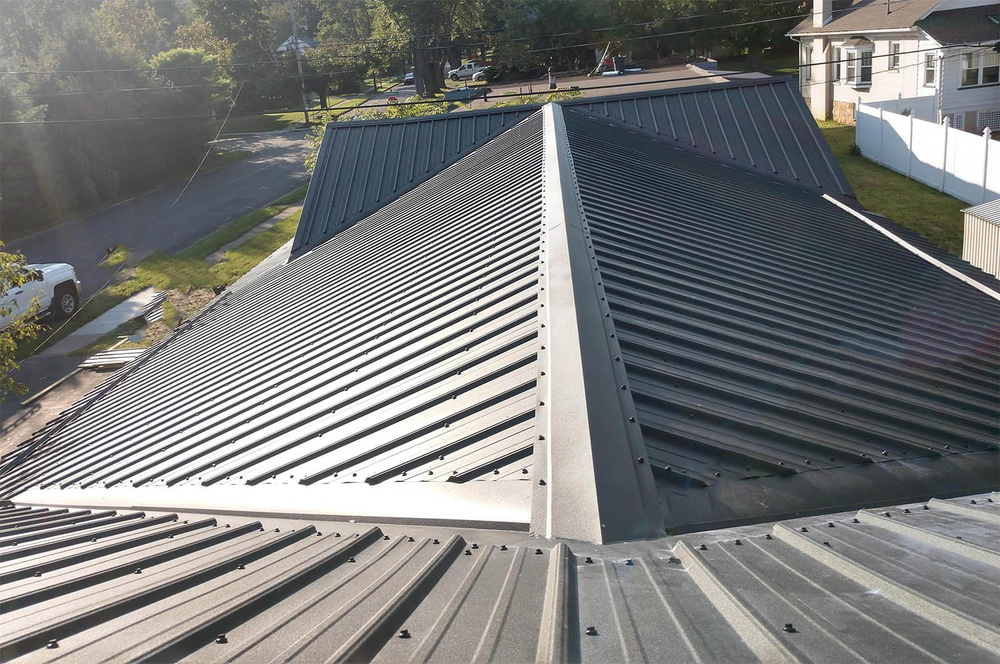
From the parking lot, look for a wavy or rippled fascia line, visible gaps at the corners, dark staining running down the wall below the edge, or coping sections that no longer sit flush. Inside, check for water marks on the wall near the ceiling line, especially at building corners. Those interior stains almost always trace back to the perimeter, not the field. I’ve had owners spend months chasing a leak in the middle of a roof that originated forty feet away at a failed coping joint.
What I Look For During a Perimeter Inspection
When I walk a roof, I start at the edge and work inward. I check cleat engagement by hand, because a cleat that isn’t gripping is a cleat that isn’t working. I look at joint covers and splice plates, since thermal movement concentrates stress right there. I inspect the membrane termination underneath the metal wherever access allows.
I also pay attention to fastener spacing and type. Undersized fasteners, or fasteners driven into deteriorated wood nailers, are one of the most common defects I encounter on older buildings in Allegheny County. The metal can look perfect and still be attached to nothing. A thorough evaluation of any commercial roofing system has to include the substrate the edge is anchored into.
Getting It Right the First Time
Edge metal is a small percentage of a roofing budget and a large percentage of the risk. That imbalance is why cutting corners here is such a bad trade. A properly specified, tested, and installed perimeter can add years to the life of the entire assembly.
If your building has edge metal that predates the current code requirements, or you simply don’t know what’s up there, get it evaluated. Understanding why edge metal matters on commercial roofing systems in Leetsdale is the difference between planned maintenance and an emergency call during a February windstorm. One of those is a lot cheaper than the other.